Search This Blog

Monday, March 22, 2010

Dead Man’s Curve

(Dead Man’s Curve) is no place to play,

(Dead Man’s Curve) you’d best keep away.

(Dead Man’s Curve) I can hear ‘em say:

“Won’t come back from Dead Man’s Curve.”

Tualco Valley Jan and Dean, 1964


The swallows are back in the Valley to stay now. All morning I have watched  them glide and swoop, silhouetted against the piles of clouds on this twenty-second day of March. It will be two weeks tomorrow since my first sighting of the year. They are violet-greens, of course, and will share our Valley until the autumnal equinox at least.

If this post meanders, I apologize, but it seems to be a perfect candidate for digression. Yesterday we celebrated Kyle Roller’s thirteenth birthday. The Rollers were our neighbors a few years back. Kyle must have been four or five when parents Darren and Cory moved here and I have fond memories of that little guy. He would yell at me through the hedge. I couldn’t hear him because I habitually wear a headset, listening to the radio when I work about the place. One day Kyle said, “Terry! You could hear me better if you took your headset off!” In the days of my strawberry farmin,’ Kyle was my robin worrier, would stand for hours at the head of the rows scattering any redbreast that ventured into the patch. He was such a dedicated half-pint scarecrow, I would have to shoo him into the house at the end of the day. Kyle's 13thNow my little buddy is a teenager, and I pray he weathers his teenage years well.

Ah, teenagers…. The other day I was waiting in line at the grocery store. The woman behind me set her basket down on the conveyor and I couldn’t help but notice the plastic “No Trespassing” sign intermingled with her groceries. “Raccoons?” I asked. “No,” she replied,”Teenagers!” Apparently some neighborhood teens were wreaking havoc on and with her property.  She said she’d like to talk to their parents. I said I had taught school for thirty-one years and good luck with that—unless it was two weeks before graduation. I told her that they were still making teenagers; every year new ones joined the ranks. And now my little ex-neighbor was “ONE OF THEM.” I’ve always tried to validate the teenage years by observing: “If it weren’t for teenagers, what would we do with all the used cars?”

And I’m walking toward Swiss Hall when I hear the car, one of those little jobs so popular with TEENAGERS these days, a little street racer, low, red—at least where the primer didn’t show—passes me, negotiates the S turn corner, and farts its way south. No other verb quite suffices for the sounds these little racers emit from their oversized mufflers. I quickly realize this little roller skate is at best a racer “wannabe.” Something is loose in the transmission: one of the gears, I think, has come to pieces and is rattling around in the transmission casing. The squat “speedster” and its two riders head south toward the grange. My attention shifts to the tirewash at the corner and the possibility of coins. Then I hear the whine, as someone said, like a sewing machine stitching in overdrive. The car has turned around at Tualco Grange and is shifting its way toward the 90 degree turn in front of Swiss Hall. Immediately I decide to distance myself from the corner and despair of any coins that may have collected there.

Now this corner is a hard right angle. Even Gladys and I have to slow our torrid pace to negotiate the curve. But it is hardly a “Dead Man’s Curve” like the fatal corner referenced in the song lyrics of ‘60’s surfer boys Jan and Dean: in spite of the warning sign—“15 mph”--a negligent driver will not plunge off a cliff, disappear into an abyss, or explode in a metal crunching ball of fire. Instead, you’ll end up in the middle of a cornfield looking mighty foolish, stuck up to the fenders in Tualco Valley bottomland. At that corner Tony Broer’s raspberry rows were always shorter; Werkhovens’ corn butchered into a miniature corn maze; fenceposts and signs sheared off and splintered. Dead Man's CurveI hear the little red speedster rev up, its driver mixing gearshift and amygdala—the brain’s decision-maker-- and from the safety of Swiss Hall’s parking lot, I hear the little car rattle its way into the corner. It is brilliant daylight; the traffic sign signals “caution” but the little racer enters the corner at an excessive rate of speed, perhaps a speedy thirty-five mph. A spinout is imminent and sure enough, the little red car slides sideway, spins, corrects, and comes to a rest in the pasture just feet away from a post warning of underground cables.near miss The vehicle following has to slow to a stop and wait while the sheepish driver ahead grinds gears, backs onto the blacktop and continues farting along at a respectable—and legal—rate of speed. Even at that distance I can read the thoughts of the second vehicle’s driver: “Damn Teenagers!” Thoughts oftentimes pretty much my own.

Sunday, March 21, 2010

Der Fruhling…

…the yonge sonne

Hath in the Ram his halve course yronne,

And smale foweles maken melodye

That slepen al the nyght with open ye

(so priketh hem nature in hir corages);

Thanne longen folk to goon on pilgrimages…

Chaucer, Prologue to Canterbury Tales

It is not quite a pilgrimage Gladys and I are on this first day of Spring; we are both up to our same old tricks: checking the Valley’s business, as usual just being snoopy.

Spring has made a bold entrance, a record-breaking 71 degrees. As I coast along, I note the cottonwoods that dot the hills to the east, High Rock, the Cadman quarry and southward are greening up. Fuzzy clumps of yellow-green patchwork the slopes. I can almost smell the sticky ooze the cottonwoods exude. Soon I will have a chance to get up close and personal with Nature’s glue when I “go into the bees” to see what’s going on inside my beehives. The stuff of propolis, this sap is, and the bees use it liberally to seal hive lids and cracks, gluing tight all that’s loose, going about their business with this hermetic stuff. It is not against stings that I wear canvas gloves when I work the bees but to keep my fingers from sticking together, to avoid embarrassing stains on my hands. Later in May, these same groves of trees will issue the soft eiderdown  that is their namesake, the piles of which I will have to sweep from the garage for two or three weeks. 

The Cambodians are harvesting their daffodils, serving them up as vernal offerings to those who want to bring spring indoors: spring by proxy, I call it; the real spring is outdoors!daffodil harvestOn the homeward leg I stop and talk to Brett De Vries who is rehabilitating an old arbor on the Streutker homestead. He said he was too cheap to buy new lumber and is making do with the old, scraping off the old paint and repainting the pieces before he reinstalls them. Brett is an amiable young fellow, easy to talk to, and in my opinion quite savvy for a twenty-something. “Cheap” further endears him to me. Now “Cheap”I understand. However when it pertains to me,  I much prefer the more formal “frugal.” 

It is not to wish Brett a “Happy Vernal Equinox,” that I cease peddling and balance Gladys on her tentative kickstand: Brett has a new well cover. I noticed it the day before and the snoopy got the best of me. I want information. Perched above the well standpipe is an old cider press. It looked in excellent repair and seemed to me an item of value that should be stored tidily away out of the weather until apple harvest.

Years ago when Garth and Toni MaGee lived in the Valley, they would invite the neighbors to a cider squeezin.’ Garth had an excellent cider press he inherited from a friend’s estate. It was a motorized two barreler: while one barrel was being squeezed, the second was being filled at the chopper. Jim Cabe would contribute a bin of apples from a friend’s orchard up north. I would contribute the muscle to twist the screw and squeeze the juice from the pulp. In three hours we would have forty to fifty gallons of cider for ourselves and friends. It was a wonderful way to spend a nippy fall evening.

(Now cider press is a painful subject in this household. Three or four years ago at Christmas my wife gifted me with a fruit press. I have yet to use it and will not burden this post with the reasons why. It still resides in its original shipping box out in the shed, has yet to squeeze a drop of juice. Someday, though. Someday, I swear: “Let there be juice!”)

Brett and I walk over to the ol’ Cider Press. He had discovered this old constrictor languishing amid piles of tools and machinery in Jerald’s red barn. Although the press looked quite functional from the road, I discovered that the pulping spindle is almost impossible to turn. When it does, the shredding wheel shreds splinters from the wooden trough that receives the fruit. Without this apparatus the press is almost useless. And that’s why it adorns the well standpipe—yard art of sorts. Brett looked at the apple trees planted about in the yard. “It seemed to go with the theme,” he said. Orchard Feng Shui. A touch of genius—especially for a twenty-something!yard art

Note: This morning I awoke “…when there was nothing left of the Equinoxes, because the Precession had preceded according to precedent…” (Kipling’s Elephant’s Child). 6:30 a.m. It was dark, whereas last Sunday it was light at the same time. So much for the spring equinox. Daylight Savings Time, that blasphemer of the god Chronos.

Friday, March 19, 2010

Stand Up and Be Counted

Tualco Valley

The fog has burned off; the sun is out; it is a brisk morning. Gladys and I head down Valley. Shortly into the ride,I see a cyclist laboring towards us and I recognize my environmentally sensitive friend Nancy L. As we pass, I ask her which way she’s going, a ridiculous question now I think about it: she was going the opposite direction. We are both out for the exercise, serious business and no time to stop and chit chat. That’s what email is for. I continue on my way; she, hers.

Swiss Hall is undergoing a facelift: a new front porch. The old one had rotted off, I guess. I had talked to the carpenter the day before. It was a three day job, he said. I wanted to see how the job had progressed.Swiss Hall Facelift Nothing had changed. The carpenter was not present.

Almost to Andy Werkhoven’s house I hear a plaintive “Slow down” behind me. It is Nancy L trying her best to catch the speeding Gladys, who is in second gear, as always, and on cruise control. Now Nancy’s bike is too sleek and shiny to name. It has so many gear sprockets a Kenworth truck would be envious. With all those gears Nancy should be able to reach liftoff speed. I leave cruise control, coast, and allow her to catch up. We continue our ride to the south end of Sky Valley Driving range where Nancy has parked her car and plans to load her bike.

A county road crew is finishing up a four month paving project—a fifteen foot stretch of pavement to repair a sinkhole in the right hand lane. I offer a bit of friendly criticism: bring the patch up to road level. My superintending is interrupted by the arrival of a county truck filled with asphalt to fill the patch. Imagine, a county crew who can read my mind.

This road less traveled suddenly becomes congested when a blue Ford Taurus,  yellow light flashing from the roof, approaches the work site. It is our Valley mailman on his morning route. To my surprise, Nancy L frantically waves him to a stop. I’m wondering what issue she has with him: she has a post office box in town. (On the other hand, we have had problems with the neighbors’ mail being delivered to our mailbox, an oversight possibly caused by our two addresses having most of the same numbers, although not in the same order. We called the post office. The oversights stopped. )

No, Nancy’s issue is with the U.S. Postal Service in general and our carrier has to field her concern: the Parker household has not received its official 2010 Census. It should have arrived last week as did ours. No Census for the Parkers. Not even the formal letter sent a week earlier informing U.S. citizens they would receive the Census the following week. As I didn’t want to leave the county crew to their own devices, my attention was divided, so I’m not sure how the conversation went. There was considerable gesturing on the part of both parties; the blue rubber-gloved hand of the mailman appeared to be holding its own.

Good luck, Nancy L. Stand up and be counted. And even if the 2010 U.S. Census does not want you counted, in my book you count a lot.

Wednesday, March 17, 2010

Sharin’ the Valley Green…


St. Patrick’s Day 2010


Where's the luck


I found my first four leaf clover of the year a few days ago. Can you find it, too?  (Photo blurry? Just pretend  you had a Guinness or two.) There’s more luck in the Valley than battered pennies. Clover patches grow prolific along Tualco Road. On my walks from now on this spring I will begin my goal of finding at least one four leaf clover per outing. I have no idea how much luck I pass on my walks. One statistic has it that for every one four leaf clover, there are 10,000 three’s There’s no slowing down to look for four leafs; the clover must announce itself as I pass by. Most times I am fooled by a couple of three leafers that have intertwined themselves and pose as a four leaf false alarm.

The traditional Irish “Shamrock” is a regular three leaf clover. It may have special powers on St. Patrick’s Day, but it’s the four leaf clover that I stoop to pluck the rest of the year.

I’ve often wondered how a four leaf comes to be. Did one of the three leaves split, round itself off into two leaves? Did that happen when some patches were visited by a mower? Is the four leafer a mutation of sorts, thus the 1 in 10,000 chance? Or, is there something else genetic going on? I tend to favor the genes explanation myself. Here’s why. It is not uncommon to find a few more four leaf clovers keeping the prominent one company. In fact the days I fail to locate a lucky clover, I visit a small clover patch that borders my garden. Every year that little patch sprouts many a four leaf; I can usually find one there without fail.

I carry my good luck home, put the slender stems in a glass of water overnight so the clover reconstitutes itself. The next day I take the clover, carefully position its leaves and press it  between the pages of two large books: A Dictionary of Slang and Unconventional English and The Norton Anthology of Modern Poetry. Each spring as I’m about to do now, I remove last year’s luck from these two tomes and put them in a plastic box for safekeeping. I like to share my luck with others and always insert a four leaf clover in each book I give as a gift. Here’s some luck I’ll share with you this Saint Patrick’s Day. 

Sharin' the luck

As I walk out in the Valley and back, I drag my surname along with me, and in this vale of Scandinavians, Dutch, and Germans I may seem right at home with the name“Johnson.” But let the truth be known:  my paternal Grandfather adopted the commonplace “Johnson” because he tired of his Slavic last name being the target of vulgar mispronunciations.  My paternal Grandmother, however, Mary Johnson (nee’ Egan) was Irish, Louisville, County Mayo, Northern Ireland. On St. Patrick’s Day my Irish prevails. And because I’m Irish, I can joke around with my Irish heritage and share two of my favorite Irish blessings:

“May you never live to see your wife a widow!”

“Get down on your hands and knees and thank the Good Lord you’re still on your feet!”

As I head to the kitchen to prepare  corned beef and cabbage in honor of the day and chill a glass for my Guinness, I wish a Happy St. Pat’s Day to each and everyone. And to the memory of my little Irish Grandmother: Mary Egan of County Mayo, Rah jay Urt, The Grace of God be with you!

Tuesday, March 16, 2010

Black Valley Gold

 Tualco Valley

I’m out in the Valley early this morning on a soil emendation errand. I have always wanted an asparagus bed of my own here on our one slim acre in the Valley and have twenty asparagus crowns ready for planting, with twenty-five more on order. I called Andy Werkhoven yesterday evening, asking for permission to take a load of digester compost for my asparagus bed. The Werkhoven farm has installed an anaerobic digester at the old Honor Farm at the south end of the Valley. The digester processes all the organic effluence from the cows in their dairy herd and produces methane gas which in turn provides fuel to run a generator that sends electricity to Snohomish County PUD’s power grid. The end products are the compost, which is why I am here,   and the waste water, which is returned to Werkhovens’ cornfields.Draggin' the mud  

Andy said to come around 9:00 a.m., and I am already a half hour late arriving at the old farm outbuildings where I find a large pile of Black Gold just waiting to be loaded. The asparagus bed awaits, and I scoop shovelful after shovelful into the truck. Pile of compost black gold

A half hour’s effort yields a load of steaming compost, and I’m all set to transport. The morning is cool and the compost smokes in the bed of the truck. I hope all this fussing will pay off in an abundance of tasty green spears next summer.

truckload of compost

I return home where I immediately unload a half dozen liberal shovelsful of compost around my rhubarb plant. The short  raspberry row receives the same treatment.

Then to the asparagus bed. A three or four inch layer in bottom of the 8’ x 5’ raised bed should do the trick. The rest I spread on my tomato/pepper patch.

Thanks to the Werkhovens’ generosity, the family garden plot should yield a bounty of produce this summer. And when the asparagus patch is in full production, Andy and family better have their hollandaise and white sauce recipes handy when I drop by with a big mess of compost-powered stalks.

Monday, March 15, 2010

Beware the Ides of March

Tualco Valley

Yes, today is the Ides of March. I expect a letter from former student Leasel Bueler sending me best wishes for the day. Years ago when I taught Sophomore English, we studied Julius Caesar in class. I offered my classes five points extra credit to the first student from each class to wish me a “Happy Ides of March.” Leasel still continues the tradition. Happy Ides to you, too, Leasel.

In the ancient Roman calendar the Ides fall on the 15 March, May, July and October. The other months the Ides fall on the thirteenth. Each month is marked by by another benchmark, the Nones, which fall nine calendar days before the Ides. The ancient Romans had a complicated calendar, encumbered even more by a superabundance of holidays (thus the expression: “A Roman Holiday.”) All we have to worry about with our modern New Millennium calendar is Leap Year, daylight savings time, and April 15.

Julius Caesar, on the other hand, had to worry about the soothsayer and the daggers of Brutus and Cassius and the other Senators. “Beware the Ides of March,” the soothsayer told Caesar, advice, history tells us, he failed to heed with dire consequences to his health.

It is with some trepidation on this day, the Ides of March, that I look out a bedroom window and notice flashing lights down at the intersection of Tualco Rd. and SR 203. “Beware the WSDOT” for the next four to six months. The left turn lane project is underway.

This morning I called the informational number on the many numerous garish orange signs posted along SR 203 (425-225-8700, if you are so inclined to have a conversation with a WSDOT project manager). I talked to Mr. Farshid Namiranian (does that sound Irish to you?) and will pass along this information pertinent to the Tulalco/203 left turn lane project. The project’s intent is to widen  SR 203 at that intersection to allow for left hand turn lanes. There will be no lane closures for shoulder work. Work on the road itself will involve lane closures from 9:00 a.m. to 12:00 and then again from 9:00 p.m. until midnight.  These lane closures may involve pilot cars to  assist traffic through the construction zone. To help with drainage (??) DOT will construct a “Media Filter Drain” from the corner of Tualco south nearly to the first residential driveway. This drain is intended to direct excess water to the culvert centerpoint on the embankment. The shoulder will be extended and the embankment incline revamped to a 4” to 1” slope (a steeper pitch than the angle of repose; any careening vehicle will still crash through the paddock fencing). Thanks, by the way to Mr. Namiranian, who addressed all my questions and concerns in a friendly, professional way as best he could.

I do have concerns about this project, and at the risk of being a NIMBY, here they are. First, the local community has had no input on this project. Two years ago I talked to  project manager Manuel J. Quinteiro (does that sound Irish to you?) about a public meeting addressing the project. Manuel and three assistants were taking some measurements along the project route. Mr. Quinteiro carried the blueprints, an assistant held a clipboard, the third a can of day-glo orange spray paint, and the fourth at the ready to pick up any item should one of his fellows drop something. Manuel said there would be a meeting and that the citizens impacted would be informed. No meeting was ever held. Matt Beebe who owns the business on the N. corner of Tualco/203 called again recently and was told there would be no meeting; the project was planned and would soon be underway. What  input would I have given were a meeting held? My first point would have been that WSDOT could save the state considerable money if they lowered the speed limit to 45 mph from Ben Howard Road to the Cadman quarry, posted a sign reading “Left Turns Ahead” with a flashing caution light north of the intersection, and enforced the reduced speed limit along that stretch of highway. This fix is not that  unreasonable. From Ben Howard Road to Cadman, a 2.3 mile stretch of road, there are ten businesses that cause traffic to slow for those vehicles wishing to turn. In these days of distracted drivers, 55 mph in this stretch is part of the problem.

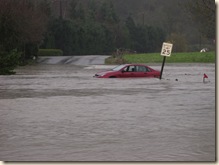
A second issue I would have mentioned concerns the hydraulics in the area: how will the new drainage system affect the flow of water during flood season. Mr. Quinteiro said the drain would need to contain a 100 year flood. I told him that unless they diked ten acres around the south-west corner of Tualco, their drain would have little effect and might even exacerbate flooding in the area. Via email I shared with Manuel photos I took during the 2006 flood. He said he would “pass them along to his manger [sic].”culvert w.viewculvert, nw.viewStreutkers '06N. HighRock R.,'06

One would hope that this project makes the intersection safer. I have concerns about the left turn lanes. Will there be a problem if  north  and south bound vehicles converge simultaneously in the turn lane? Will the traffic turning north from Tualco Rd. have to cross two lanes of traffic (if the south bound turners to N. High Rock Road congest the turn lane, especially during hours of peak traffic flow)? Nearly all the accidents occur in the afternoon and involve inattentive drivers at speeds in excess of 55 mph rear-ending vehicles turning left to High Rock. I can think of only two accidents involving northbound traffic at that intersection. Both happened last summer. One involved a car turning into the businesses at the latte/fruit stand site. The other involved a motorcyclist who tried to pass  on the right a pickup towing a boat  and got tangled up with the boat trailer.


One final comment before I close this post. June 30, 2008, there was a double fatality accident at the project intersection. The accident involved a motorcycle traveling south on the fog line at a high rate of speed. A vehicle driven by a teenage girl, who did not see the cycle, pulled out, and was T-boned by the cyclist. Neither driver survived the impact which was so violent it flipped her car. My comment: there’s no left turn lane configuration in the world that can prevent stupidity.Tualco 203 2 fatality


Update: The project preparations continued today. The subcontractor, CSI, laid a "compost sock" along the project route. I talked to Tom, a supervisor, about work hours. He pulled a three-ring binder from his pickup and thumbed through about 400 pages of project info. Sorry to say, those of us in the construction zone are back to sleepless nights. Here's the work schedule according to Thomas: Monday through Friday, day construction from 9:00 a.m. to 3:00 p.m. Second shift: 7:00 p.m. to 5:00 a.m., Monday through Thursday. Plan your trips to town accordingly.

Friday, March 12, 2010

Blow Winds and Crack your Cheeks...


Raved crazy old King Lear as he pranced about naked on the moors, baring his soul and skin to the "hurricanoes"(but then Lear had three daughters). This morning the wind whips across the Valley, lingering a bit on the hills to the west and then rushing full tilt across the flatlands. Ranting is on my mind, and I can rant as well as any crazy old King--and with only one daughter, too. But then just as a horse likes a good startle, I welcome a good rant.The DOT's turn lane project on SR 203 at Tualco and N. High Rock Roads, five years in the planning (or procrastinating) is underway. A couple of days ago we heard a gentle "tap, tapping" across the road, opened the shades and were blinded by a day-glo orange fence that stretches two or three hundred yards north along the shoulder of the east side of the highway, the harbinger of construction noise, road delays and general aggravation from now until October. This mockery to the eye (the color alone is enough to deter litter; couldn't they have used "camoflage" to accomplish the same objective?) is called a "silt fence" and purports to keep construction debris from sensitive areas (the slough east of the road is designated "wetlands," a word loaded with all sorts of environmental implications and impediments). I wonder at its effectiveness. This morning's gusts have blown down a couple sections already, and if the fence can't even keep out the Valley's zephyrs, it won't stand a chance against a chunk of asphalt.

Looks like, too, that construction may very well be round the clock. We could be sleepless in the Valley for eight months.You might want to call the number on the garish sign posted by the horse paddocks to see if you'll need earplugs and blinders to get some shut-eye come summer nights.

Road construction of any kind is so commonplace that it's hardly news, but when it occurs almost in your front yard and creates a disruption on par with the Great Valley Flood of '06, it warrants mention. Besides, for Gladys and me this highway project is certain to hinder access to the Valley. And it will be a frustration to the Valley folk who leave and return here during the day. This is big news. And I shall report it. Just don't expect a non-biased reporting. There's nothing objective about a rant.

(Note: maybe nocturnal peace and quiet will be ours after all. The sign above is NOT the one posted earlier in the week. I am certain it read "call about night work.")