Search This Blog

Sunday, August 15, 2010

Well-Preserved from the Valley…

Pickle me thrice

Yesterday the author returned to the classroom for the first time in ten years. No chalkboards here. No first of the period roll taking. And I did not have to give a single assignment. And better yet, did not have to correct any.

 Pare a peel

I brought some of the Valley with me for show-and-tell: all local produce I had dried, jammed, pickled or frozen. In fact that was pretty much The Valley, pickledthe title of my presentation at the Pacific Culinary Studio in Everett: “All Dried Up, Jammed, Pickled and Frozen.” No sophomores in this classroom; just four attentive adults who were interested in the “laying  by” of local fruits and vegetables.Attentive class

Instead of a piece of chalk in one hand and a book in the other, I wielded a vegetable peeler and top-of-the-line kitchen knife. The Culinary Studio features a marvelous demonstration kitchen and is well-stocked with the culinary accoutrements that would make any chef feel at ease. For audience optimum viewing every movement I made, clumsy or otherwise, was reflected by an overhead mirror and and aired on a closed circuit t.v. 

Closed circuit


Reflects well on me

While the class munched on dried zucchini slices, tomatoes and apples, I proceeded with my presentation. And for the next three hours I felt like PBS’s George Ray, without a moustache, of course, and doing the actual work instead of standing by snatching up the food as it arrived hot from the stove.

Mine was a live performance, a first time run through with no rehearsal: no script to follow; no editing of mishaps or inept fumblings. My tutorials included drying apples, freezing blueberries, and pickliDrying applesng beets (2 jars, pint and one halfs; my fingertips this morning are still a blushing pink) and a pint jar of gourmet sweet cucumber pickles (from immature gherkins picked  fresh from the vine that morning). I capped off the performance by sharing my experiences preparing jams and jellies, gave a short explanation of my homemade preserves: pepper and quince jelly, quince-apple marmalade, and cooked strawberry jam. 

Blueberries to freeze

In the last few minutes we moved from show and tell to show and tell and taste when the class sampled my jalapeno pepper jelly spread on crackers and cream cheese. (Sorry, class, I forgot to share the refrigerator pickled beets, just plain didn’t set them out.)

From my days in the classroom I learned that “To teach is to learn twice.” It was true then and certainly held true yesterday. I learned that every man needs an island, a cooking island, that is. I nearly learned NOT to leave the heavy handle of a sauce pot over an ignited gas burner (thanks to my observant wife Trecia. Because of her vigilance the class was most certainly spared an expletive undeleted in this live performance). I learned “it’s as easy as cooking with gas” ain’t all that easy. And I learned, sadly, there’s even less hair on my head than I had thought.

Bald spot

Before I exit this post I would like to extend a few thank-yous. A well-deserved thanks to Lindalee McCandlis for her fine facility and allowing me the opportunity to share my love of home canning and food preservation with others. Thanks, too, to my wife--and partner in food preservation--Trecia for helping me prepare for the class and keep my wits about me during the session

Lindalee

And class, thanks for your patience and attention for a session that went longer than scheduled. A good class you were too. Not a single time-out issued. Not one hour of detention assigned.

Friday, August 13, 2010

Got Old Tractor…?

Big Valley Doin's

The morning mist lifts from the Valley, unfolding like a down comforter into a sky that spurns clouds. Out for an early ride in the cool air, Gladys and I glide into the driveway at the Frohning Family Farm where we thrill to the sound of a mandolin pickin’ its way through that old Bluegrass classic “Salty Dog Blues.” A fiddle and guitar blend in and if Gladys had feet, she’d be stomping her brogans to that good ol’ country music.

A voice croons, “Let me be your Salty Dog or I won’t be your man at all…” from a loudspeaker on a pole. It is August and we are here early on this first of the three-day annual Valley extravaganza that does homage to that indispensable helpmate on the American farm, the tractor.Puller of yesteryear And if you have ever owned a tractor, driven a tractor, or ridden one, you need to visit the Frohning Farm sometime between now and Sunday.


Oldtimers


Sporting new paint jobs, their Armor-All-ed big tread tires glint in the morning sun. You have to squint to look at them. Every make and model of vintage “puller” is on display. You got your McCormicks, you got your Fords, your Massey Fergusons, your Olivers. I see a couple old Cases. A few shiny International Harvesters have made their appearance. As always, there’s an Age and beautyimpressive contingent of the old “Poppin’ Johnnies,” lined up and gleaming in their Sunday go-to meetin’ John Deere green.

I wander between the rows of old timers and then I see her, a vintage gun metal gray Ferguson and suddenly I’m back in the apple orchard of my youth, sitting on that spring seat, puzzling over how I’m going to get that big right tire  off the tongue of the orchard trailer I’ve backed up on. I’ve got the Ferguson at right angles to the tongue, backed up against it and I’m stuck. And man, is this young country boy ever embarrassed! So there I sit idling in neutral until one of my co-workers, an old tractor man, frees the two of us.Old FergieYes, it was “Old Fergie” that ushered me into the world of motor vehicles. This reliable gray machine, with her four-speed trannie,  taught me clutch technique: “let her out slowly, while givin’  ‘er the gas” with the old hand throttle. And after a few weeks of her gentle understanding, I learned to shift smoothly from one gear to the next and reverse any orchard trailer with the best of ‘em.The gray ghost Yes, time rolled back…. I was proud to pose Gladys by my old, gray friend.


  Two vintage ridesI wasn’t the only one waxing nostalgic this morning. I run into Trouble # One and his sidekick Trouble #two, those Rollers, Darren and son Jesse. Both have just finished pounding back their five dollar breakfasts. Roller has brought his pride and joy, a 1966 Jacobson riding lawnmower, the exact model that in his youth fueled his love for trimming the green. “Born to Mow” is that man’s motto. And there she sits this early morning, all tricked out in orange glory, her chrome wheel covers a’ glint with delight at that prize ribbon dangling from her engine cowling.

 A couple of mowin' foolsRoller's orange babe


Over the three day affair, which features several tractor-related events including a grand parade of these old classics, spectators can experience an old-fashioned threshing bee, a throw-back to the days that pre-date our modern grain combines when reapers first cut the grain, then gathered it into shocks and hauled it to a steam-powered thresher, which then separated grain from chaff.

Reaper

Craft booths and other curiosities complement the show. If you want to bring a curio Saw blade arthome, I suggest you stop by the saw blade art booth where old saw blades are turned into works of farm-related artwork.  As you saunter about, though, be careful.  I spied a sprightly old couple in a vintage jalopy motoring around the grounds. At their age I have my doubts they should be behind the wheel. Besides, these two seniors seemed more interested in each other than watching the road. Senior drivers Keep your mind on your drivin'

Be sure to bring the kiddos, too. They’ll love the hayrides, toy pedal tractors, coloring contest, and petting zoo. Let them become tractor men themselves at the photo board.

A country boy


An old hayseedAnd no one need go hungry, either. Not with the five dollar breakfasts and other food venues to choose from. 


5 dollar breakfast

If you have a hankerin’ for some good ol’down on the farm fun, take a jaunt to the Frohning Farm this weekend. Enjoy this wonderful event in our spectacular Valley. Weather’s great. Come, take a look see, listen to a little Bluegrass (if you can hear it above the pop, pop, poppin’ of those old farm classics). But unless you’re a young ‘un under twelve, better come flush with cash.Admit one rich personGladys and I just flashed our press passes, however, and entered free of charge. What’s not to enjoy about that!

Saturday, August 7, 2010

The Taste of a Poem

watermelon pickles

You can grow a lot of crops in the Valley but watermelon isn’t one of them. Cucumbers, their kissin’ cousins, do well. Season’s too cool and short for melon production; even if the gardener’s lucky, tomatoes end up fifty-fifty red and green at season’s end. Explains all the recipe books on the many ways to cook, can, and preserve green tomatoes. Watermelon thrives in climes of hot days and warm nights. Here in the Valley a melon crop could only come from an artificially enhanced climate: green house, that is to say. If it can’t grow in the backyard garden, it has low priority in this household (this year I wrote off okra as a lost cause). However because of a poem I read years ago, I have been long intrigued by a watermelon by-product. The subject and sentiment of that poem inspired me to don a kitchen apron and launch myself into a recipe that would result in a batch of watermelon pickles.

John Tobias’s“Reflections on a Gift of Watermelon Pickle Received from a Friend Called Felicity,”is a seasonal lament, a longing for summer, for those lazy hot months, represented in his poem by the hallmark fruit of the season—when “watermelons ruled.” “Reflections…” evokes not only summer but summers long since fled, “when unicorns were still possible;” the summers of six cents a pound watermelon, family picnics when we spat or tiddly-winked black seeds from thumb and forefinger. Our chins, those days, were none the worse for being sweetness-stained from the cold juice; our backs youth-resilient to the bent postures we assumed to deflect the flow of liquid from clothing or bare chest, allowing it to dribble to the ground in thick drops. You knew what flesh was prime and plumbed the pink depths until you reached the core, the heart, where the sweetness dwelt. Remember the paper plates with the teeth gnawed leavings, the green crescent rinds, their inner curves a blushing pink. These we discarded in trash cans, the rinds sometimes pitched into nearby weeds where ants soon peppered them. Could one pack that much memory in a jar of pickled rinds, I wondered? I thought I’d give it a try.

Like anything else homemade, I found time was the ingredient most required here; there’s no microwave swiftness possible in preparing a batch of watermelon pickle. I began by removing the flesh from one medium-sized watermelon (on sale at Freddie’s but not at the six cents a pound we paid in the 1950’s), set it aside for “future use,” and then set about paring the skin from the rind. Next, I chopped the peeled rind into one inch chunks (12 cups required; I used it all). Then I prepared an ice water salt brine in which I steeped the rind for eight hours. After the eight hour brine bath, I rinsed the rind thoroughly in cold water and prepared the pickling brine: sugar, white vinegar, a spice packet of cloves and allspice (whole), which I brought to a boil and then poured over the watermelon rind. Added one whole lemon, thinly sliced  to the mix and steeped for another eight hours. (In the the meantime I needed a good night’s rest.)

The next day I placed brine, spice packet, lemon and product into a large kettle, brought the mixture to a boil, reduced the heat and let the whole business simmer for another hour. The end was in sight now. I ladled the hot pickles into wide-mouthed pint jars, popped a whole stick of cinnamon in each jar and processed the seven pints in a steam canner for fifteen minutes. And though I was considerably older than when I started, the end result looked quite appealing.


finished pickles


Double pickle

Now the jars sit in the dark in the garage pantry, waiting until some snowbound January evening, when the nights are long and cold and the winter tiresome. Then in the warmth of the woodstove’s glow, I will open a jar of watermelon pickle and discover if:

The summer which maybe never was

Has been captured and preserved

And when we unscrew the lid

And slice off a piece

And let it linger on our tongue;

Unicorns become possible again.”

And if Tobias’s claim proves true, I’m sure I’ll find a friend I can gift with my watermelon pickle, brush aside the misery of winter, cast off the dreariness of spring, and bring a burst of summer rushing to the tongue.

Pickle trio

Monday, August 2, 2010

Up to Your Boot Tops in….in the Valley

plumber Andy


The other day Gladys and I were meandering through  the Valley and happened upon a little excavating project on the lower Loop road. At the end of a ditch dug by a backhoe machine, down in a hole, shovel in hand, was Andy Werkhoven and associate. They were puttering (or puddling) around in a pool of …well, let’s just say a pungent, green liquid. The digester feedline had stopped up, backed up, clogged up by the solid wastes from the dairy. No supply to the digester, no methane by-product; no methane, no fuel for the generator; no generator, no electricity surging onto the power grid.

“What’s going on here?” I ask Andy. He gestures with an arm that sports a green ring nearly up to his elbow. “We’ve had a little blockage,” he smiles. ( Ah, ha, a constipated poo poo line!) I notice a bilge pump is hard at work keeping the bilious liquid from flowing into their boots. No need to stain your socks, if you can avoid it. He’s in the process of installing a valve that would serve to purge further blockages by using a high-pressure water stream. I have my doubts, but Andy’s sure it will work.

I ask Andy if I could digitally record a man at work in a pool of bovine waste. “Am I going to be on the internet?” he asks. “Most likely,” I reply. He smiles and continues wrestling with the 6” supply line. “You want people to know what a….business dairy farmin’ is?” Andy laughed. “Actually,” I replied-- Werkhoven Dairythough any walk or ride by the dairy barns pretty much high-profiled the presence of Andy’s barnyard vulgarism—“I try to run a clean blog. I’m afraid I’d have to call forth a euphemism for such a colorful term.” My comment opens the door for Andy to relate the oft-told anecdote about President Harry S. Truman. Apparently Truman came under fire by some prudes who complained about the President’s persistent use of the word “manure.” Wife Bess came to his defense and told the group, “You ought to thank me: it took  forty years for me to get him to say that!”

Andy’s story reminded me of my days in the classroom, teaching sophomores Latin and Greek roots, prefixes and suffixes as a way to unlock the meaning of an unfamiliar word. “Man, “manu,”I told them is a  Latin root (fem.) for hand and proceeded to give examples, “manufacture: to make something by hand; “manual labor”: to use one’s hands in work; “manuscript” a document written by hand. “Manure.” (I had their attention now.) “Something you don’t want to get on your hands!”

As I note the green hue nearly up to Andy’s elbows, I hearkened back to the days of yore when I, too, stood in a liquid-filled hole, shovel in hand, wrangling with a drainpipe. I related this story in my memoir Growing up Riparian: A Columbia River Boyhood. That day I worked in a different medium than Andy, but the tint was much the same. I had been assigned the job of freeing a blockage in a 4” galvanized pipe, part of a drainage system that drained runoff irrigation water away from a section of orchard. If the system failed, the trees would die from overwatering. I ran a plumber’s snake down the pipe until it was stopped by the obstruction. Marking the free end of the snake first, I pulled out the remainder, stretched it out on the ground above the pipe’s path, determined at what location I needed to dig the hole to access the blockage.

I dug the hole and used a cold chisel to split open the pipe. At this point the backed up water quickly filled the hole, and I was suddenly working in water shoulder deep. I peeled back the metal far enough so I could reach into the pipe to feel for the blockage. I groped around and soon found the obstruction. My hand closed around a cluster of teeth and a small skull.  I quickly withdrew my hand in alarm. Then I realized what was blocking the pipe. A skunk had crawled into the pipe opening, tried to pass through,  and in its attempt got stuck and perished. My job was to remove the carcass. As soon as I realized the skunk posed no further danger, I proceeded to dislodge it. The head was firmly lodged and would not budge. I moved down the pipe to the skunk’s posterior, hoping to free it from that direction, a breech extraction. My hand closed on the tail. I tugged. In early stages of decomposition, the skunk’s flesh gave way; the tail slipped off in my hand. At that instant the musk glands ruptured and immediately a putrid liquid rose to the surface of the water, coating my arms a green much the same hue as that coating Andy’s today-- accompanied, of course, by a more potent smell so strong I nearly lost consciousness. Pulling on the tail like a rope, I was finally able to wiggle the corpse free of its watery grave and the water flowed through once again. A couple of hours in the river and two bars of soap later, I was finally allowed in the house for dinner.

I had been wanting to talk to theMuckin' it out Werkhovens about the new system they had in place to convert dairy cow by-product into electricity. That’s why Andy was now laboring in the hole: to clear the supply line and restore the flow of organic to the anaerobic digester at the old Honor Farm. “Andy,” I said, “I’ve had some questions I wanted to ask you about your digester system, but every time I see you, you’re rushing here, rushing there, always on your way somewhere to do something. Just a wave as you fly by.”


Up to their knees in it

He stopped for a moment (or  just shifted position, maybe?) and said, “You know, you’re right. I was out in the field the other day and saw Mt. Rainier. I told myself, ‘This is such a beautiful Valley, I need to stop and smell the roses once in a while.” I looked at the green tint on Andy’s arms, breathed in the Valley’s aroma up close and personal, and thought: “Perhaps that cliche’s not the appropriate context for your present labors, Andy; a florist’s van full of Mr. Lincoln roses could pull up right now and be totally cancelled out.” But again, maybe after a day of wading in cow “manure” that’s what a dairyman needs. I didn’t tell Andy he needs to be careful about pausing a moment to reflect on the beauty, the purple mountain’s majesty of Mt. Rainier. I did that last Sunday and it bought me a whole lot of trouble.

Thursday, July 29, 2010

Post Script on a Post Op….

Bob Post-op

I had not heard from Bob since last Sunday night when I gave him a lift home after his surgery to repair a badly fractured collarbone. In this day and age of helter skelter lives and the advent of stress, folks are more reluctant than ever to “get involved.” (Let me qualify that in Bob’s case: while we assisted the fallen cyclist, perhaps a half dozen motorists stopped to ask if they could lend a helping hand.) I was not sure I wanted to become more involved in Bob’s affairs and misadventure than I already was, and so I did not bother to ask for his cell phone number (his only means of communication). His bike had been secured safely in our garage waiting to be retrieved.

Yesterday Bob and a neighbor stopped by to pick up the bike. Bob looked pretty much the same as he did when I left him, arm in a sling, his surgery dressing partially visible beyond the collar of his t-shirt. When I asked him if he was able to fill his pain medication prescription, he said, “No, I didn’t go pick it up.” “What about the pain?” I asked. “It’s been pretty intense, especially last night.” It’s been an ibuprofen routine for Bob since the surgery: three tablets every four hours. Bob said the tablets worked pretty well for the first hour. I asked him if the dressing had been changed since Sunday. “No,” he said. “The doctor gave me some post-op instructions, but I couldn’t do them by myself.” For four days he had done nothing  to make himself more comfortable or insure the surgical site was clean and free of post-op infection. I noticed his little late model Ford station wagon was a stick-shift; Bob had to shift with his good hand, steer with his good arm when he needed to get behind the wheel. I was relieved to learn he’d scheduled a Dr.’s visit for this afternoon.

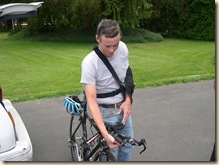
But all of this seemed a secondary interest to the Sarge. His main concern was the condition of his bike. He checked it thoroughly fore and aft: if the wheels tracked straight; if the shifting mechanism functioned to transfer the chain from sprocket to
Checking his ride

sprocket. Bob checked the seat (which he had customized to fit his spare posterior). Checked the pedal action, the tension of the spokes,  damage to the fork, noted all the scratches, dents, closely examined the entire machine for any other accident-caused blemishes. He went over his ride like a one-man pit crew for the Tour de France, even showed me the gash in his helmet, the spot where his head struck the pavement. Bob pointed to the dented helmet and said, “ But for this, now I’d be sitting in a nursing home somewhere with drool running down my chin.” Bob noted a slight skew to the front wheel. “The rim’s bent,” he said. “Well, I have another wheel at home.”

Home? Sunday night I discovered what “home” meant for Bob: a considerably more than “gently used” camper, and a small one at that (no sleeping compartment), surrounded by the hulks and heaps of mildewed aluminum homesteads that had probably once sat on wooden wheels. “Three Rivers Mobile Home Park,” harkened back to the Hoovervilles of the Great Depression. It was a Spartan existence Bob lived, in an ambience that Spartans, I’m sure, would have considered spartanly extreme. I will defer further description out of courtesy to Bob (nor will I post the photos I took of his “Home, Sweet, Home), but the thought that he lived a life as lean and spare as he himself (127 pounds, 5’ 6”), yet owned a bicycle worth at least two, perhaps three K, gave me some pause, I have to admit.

Upon hearing of Bob’s plight, my daughter, an empathetic and compassionate young lady, took it upon herself to research the kinds of assistance a sixty-one year old former service man (U.S. Navy) with no health insurance and a busted collarbone could fall back on should his situation require it. She contacted the Snohomish County Senior Citizen Assistance program and learned of several services Bob might avail himself of should he choose to do so.

The informational packet arrived in yesterday’s mail. Around ten a.m. this morning I hand delivered the packet to the trailer park and Bob’s camper. He answered my knock and I handed him the packet, which he opened immediately. I had included a personal note in case I found no one at home, apologized  for “meddling,” but had done so only out of my concern for him and his situation. I was relieved when he said, “You’re not meddling; I appreciate your help but I’m not a senior citizen.” “Well……..,” I said, and nodded an affirmative. I told himI had forgotten to hand him the material the day he stopped by for the bike and to feel free to do what he wished with the material. “I’m pretty independent,” he remarked. Yes, I thought, but  “independent”  don’t chase away the pain.

We stepped outside into the pungent smell of cat  feces and urine. “Let me shut the door,” Bob said. “I don’t want the mosquitoes to get in.” We discussed the invention he has staked his scant bankroll on: a sensor that measures tolerances to micro-distances, one he hopes to peddle to the airline industry. “If it ‘flies,’” he said, “I’ll be able to buy my own jet!”The testing phase begins in Lynnwood next week .

The mosquitoes had discovered us by now, droning  away as they maneuvered to slip in under our tolerances. A dog tethered to the trailer next door yapped incessantly. I heard a shout, not a gleeful shout, but angry, tinged with a frustration bordering on….despair, perhaps? “Good luck with the sensor,” I said. “Life’s like an elevator,” Bob replied and smiled his Spartan smile: “Sometimes it takes you up; other times you get the shaft.” I shook his hand, glanced at his bandaged shoulder, once more at the dilapidated little camper that was his present life, and as I returned to my truck, weaving my way carefully between the sand-encrusted piles of cat droppings, I felt I pretty much knew where Bob’s next elevator ride would take him.

Wednesday, July 28, 2010

The Valley at Stud

zucchini


Now that title grabbed your attention, didn’t it? And, no, it’s not a cheap dodge to get you to read this post…nothing like John Gierach’s Sex, Death, and Flyfishing. (I wonder how many readers rushed to buy Gierach’s book for the “sex,” only to discover the author used the subject in the context of the natural history of the mayfly?) Sorry to disappoint--the subject of this post is zucchini, but now that you’ve read this far, you may as well suffer through the rest.

The other day I answered the door to admit my environmentally-sensitive friend Nancy L. A little plastic bucket dangled from her hand. The bucket contained a clippers and a soft-bristled artist’s paintbrush. Ah, ha! I know what she’s up to this morning: a little vegetable sex, zucchini sex, to be specific. This mission is a repeat of last year’s, and I’m wondering what’s going on with my friend’s squash. Is she using Amazonian seed, seed that excludes anything male, like the warrior women of myth? Does her zucchini belong to some secret female society, the seeds of which sprung from the Isle of Lesbos? Whatever the case, Nancy L fears a dearth of zucchini, something that has never happened in my garden. Even early into the zucchini season, I’m wishing my plants would practice a little abstinence.

Zucchini is a monoecious plant: each bush produces both male and female blossoms—at least mine do. Nancy’s, on the other hand, seem female profuse; the men are no shows.


female zuke

What she has brought with her in the bucket is zucchini sex paraphernalia: she plans to snip a few male blossoms from my plants, take them home to the female blossoms and gently paintbrush the ladies with the male stuff. Without this special masculine pixie dust the female nubbins will show promise at first but then turn yellow, shrivel, and rot. There would be no zucchini bread in the Parker household this year. No zucchini relish. No steamed, baked, sauteed, fried, stuffed or salad-sliced zucchini either. Nancy is here to prevent a zucchini catastrophe.

We go out to the zucchini patch. It is midmorning and the blossoms are still fresh, haven’t begun their midday, early afternoon wilt. We find two or three male blossoms.male zuke They beckon to Nancy: “Take me! No, take me! I’m your man! Bring on the ladies!” Nancy enjoys being the matchmaker, selects a couple promising gents, snips them from their stalks. She pops them into the bucket. With a hasty “thanks,” she hurries off.  Nancy is anxious to perform a little artificial insemination in her own patch, bring home the grooms; she must rush home quickly before the ardor cools.

You’re more than welcome, Nancy L. Feel free to visit my zucchini plants here in the Valley anytime, a Valley where men are men—and women too! Well,  at least where zucchini are concerned, .

Monday, July 26, 2010

No Cryin’ on Bob’s Shoulder…Not for Awhile Anyway….

Sargent Bob

This a far different post than I had intended to write about my friend Bob, a fellow Valley walker and cycler. Most of our meetings, Bob was afoot, and I was on Gladys;  our walking routes did not overlap. I called him “Sargent Bob” because he lived somewhere up Sargent Road north of the Loop Road. If I hadn’t seen him in a while, I would stop for an update, chat about the Valley happenings. Whenever I was on Gladys, Bob would give me advice about bicycle safety: “You need to get a helmet and wear it!” he warned. Bob felt free to share other advice with me,too: how I needed to adjust Gladys’s seat so I wouldn’t “blow my knees out”; how to trim my food intake (I had complained about all the Christmas baked goods…) so I could shed some weight. “You have the rest of your life, you know,” Bob would say. “At our ages we need to do what we can to insure quality of life. I eat to live,” he’d say, “not the other way around.”

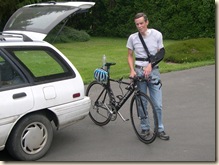
I only have one photo of Bob because for some reason he was camera shy. I snapped the shutter quickly one day when we met at Frohning Road. He had stopped to investigate a bike someone had dumped or discarded in the weeds along side the road (turned out it was Timmy Lee Frohning’s transportation to and from the bus stop on school days). For all I know, the above photo may be the only one taken of Bob. Like the Sioux chief Crazy Horse perhaps he thought the camera might steal his spirit. All I know is he was pretty strong-willed about a lot of things.

I hadn’t seen Bob in the Valley for quite some time. But through a bizarre intercession of Fate, we met yesterday morning. A beautiful morning it was, too: clear blue skies, lots of sunshine melting away the Valley mist. A good morning to share with Gladys before the day heated up.

As I rounded the corner headed south, Mt. Ranier loomed ahead like a huge ice cream sundae. “What a great photo opportunity,” I thought, and planned to extend my ride past the old Honor Farm and Werkhovens’ digester to my favorite prospect of the mountain. I believe it was this decision and at this point where Fate started building its case against Bob and me.

Just as I reached my photo station, Fate stepped up the pace and drew in my environmentally-sensitive friend Nancy L. She was on her way to Church this Sunday morning. When she saw me,  Nancy pulled off on the shoulder to chat for a minute or two. We had hardly exchanged greetings, when she said, “Here comes a bicycle” and she edged her car forward a bit further onto the shoulder. I looked up in time to see a cyclist tooling toward us, going flat out. I told Nancy L he better not make sport of Gladys. At that moment I realized he was heading straight for us on a collision course. And here Fate dealt the coup-de-grace. In disbelief I thought: “He’s looking down at the road. HE DOES NOT SEE US!” I didn’t even have enough time to shout a warning. I thought the cyclist at the last moment would swing to the left around Nancy’s car, but instead he plowed between us on the right, narrowly missing me (and the back of Nancy’s car; Fate momentarily blinked) and sent Gladys flying into the weeds. And then just beyond Nancy’s car there was the eerie sound of scraping metal, the awful thud of body on pavement. I rushed to the scene and lying among the tangle of metal, Spandex, shattered water bottles I am shocked to find Sargent Bob. The Sarge is down in the dust and not moving.

By this time Nancy L is out of her car and beside us. A pick-up stops and the driver asks if he should call for aid. Bob sits up. He is dazed, doesn’t know what’s going on until he hears “aid/hospital/emergency room.” That seems to bring him around some. Bob whispers he can’t go, doesn’t have insurance. Another motorist stops to render assistance. He seems to know first responder procedure, moves his finger back and forth in front of Bob’s eyes, asks him to follow his finger. We note Bob has an unusual knob protruding from his left shoulder about two inches left of his neck. That cinches it. Its the ER for Sarge.(“You have the rest of your life, remember?”) Nancy L drives me home for the truck while the Good Samaritan first responder stays behind with Bob. I return with the truck. We load the bikes in the back, and Bob, amid protests of no insurance, in the front, and head for the ER in Monroe.

At the ER a nurse checks Bob’s vitals. Except for that shoulder, he is in tip top shape( all that exercise and the “I eat to live” philosophy paying dividends). Then x-rays of the shoulder and a visit from the on-call orthopedist. The x-ray shows a broken clavicle. It’s a bad break, the bone has snapped near his neck, thrust upwards, and the longer section compressed under the shorter. As the bone has penetrated flesh and tissue, surgery will be required to disinfect the wound. Then the break must be plated and and the collarbone pinned—perhaps wired-- back together. Bob repeats his oft-used litany of the morning: “Well, this day sucks!” I stay with him until he’s prepped for surgery, leave my phone number so he can contact me later. At this point he seems to have no one to assist him but me. I am glad to do so. Can’t help but feel I was in some way Fate’s helpmate in his plight.

Around three o’clock in the afternoon Bob calls. The operation is over; he is in recovery, thinks he will be released that evening. That’s highly unlikely I thought. But I was wrong. Bob was released at 7:30 last evening. I meet him at the nurses’ station in the ER. His arm is in a sling. A big wad of dressing like a football player’s shoulder pad bulges at the point of surgery. He can’t wait to leave. We walk to the truck. “Well, this day sucks!” he reiterates. It’s about 8:15 when I deliver him to his camper at Three Rivers Mobile Home park. I help him dump a bag of ice into his refrigerator, tell him to take the ibuprofen every four hours as the Dr. advised until he can pick up the pain medicine prescribed him. I wish him good-luck and tell him his bike will be safely secured in our garage until he’s ready to retrieve it.

I haven’t heard from the Sarge this morning. I can only imagine that last night “sucked” for him, as well. As I reflect on yesterday’s incident, I am bewildered at the irony of it all: how three people who know each other from the Valley (Nancy L, like me, has seen Bob on his Valley walks countless time), can meet at the same time and place with such dire consequences. But Fate plays no favorites, is relentless.Yesterday it showed no regard for metal or flesh and bone. Bob’s hi-tech bike has a warped front wheel; Gladys suffered a bent rear fender(she’s one tough cookie and most certainly will roll again); Bob’s summer of cycling the Valley has come to an abrupt end and Nancy L and I are bit shaken emotionally. Yesterday’s incident reminds me it’s high time I visited the local bike shop. If I may borrow my hapless friend’s phraseology: “Fate sucks.” Why tempt it more by not wearing a helmet?