Search This Blog

Wednesday, March 11, 2015

Gladys Breaks Wind…

GladysI’m on mare’s shanks again in the Valley. Yes, hoofin’ it is my principal means of transport these days and I’ll be afoot indefinitely, I fear. A few days ago I was spinning along on Gladys and coming up on the Barrell Man’s house when I heard a sharp crack and subsequent whistle, then a long sighhhhhhh. I can’t approach Martys’ place without thinking about moles: their property is currently under heavy siege. My first thought was “gunshot,” and too close for comfort: the Martys are fighting back. Or am I, myself, under fire? A quick glance at my surroundings revealed no weapon, no shooter, no need to hit the deck. In quick order I processed the situation: Gladys had just plain let me down. Down in front anyway. Her front tire as flat as a pancake. Strike that last: The Ripple can do far better… flat as the Earth before the Enlightenment….flat as a three-day old ‘possum on a state highway… flat as…. In short, Gladys had gone flat out. In the Old Gal’s favor, though, she didn’t leave me far from home; I always expected she’d strand me somewhere on the lower Loop, near the point of no return. I parked her next to a laurel bush across from Martys,’ footed it back home for the truck, retrieved my vintage ride, and hauled her home, dignity still intact.

Human nature seeks to find a scapegoat, point fingers, fathom out the well-source of blame while denying complicity. pancakedGladys and I have been gliding the Valley for years with scarcely more than an occasional wheez from the old harridan. So invoking the spirit of human nature, I armed my forefinger, and like a water witcher with his willow wand, waved it around until it waggled and settled upon the culprit, none other than Jimmy Dennis, as the root cause of my current pedestrian status.

Jimmy Dennis, the Valley’s diminutive self-appointed block watch captain. How many times have Gladys and I waved as we passed? How many times afoot have I high signed the Valley monitor, the sentinel of Tualco? Just the day before Gladys left me pounding the asphalt, I’d flagged Jimmy down, coincidentally, adjacent to the Frohnings’ mobile chicken hut and, tongue in cheek, chastised him for his laxity in guarding the hen house. Two days before, Sandy Frohning had led me to a pile of feathers that the day before had been her prime 3-P rooster, guardian of the hutch, now reduced to a pile of down and feathers that would scarcely fluff a small pillow. “You’re falling down on the job,” I tell Jimmy. “Whadddya mean?” he replied, and I break the sad news of of the guardian of the flock, lately deceased, victim of a coyote prowl. My gentle jest prompted a rant, a tirade from Jimmie D in which he excoriated the very existence of coyotes and eagles. Of the latter something about their numbers not warranting the “endangered species” ranking. My ears singed and the fumes of vituperation burning my nostrils, Gladys and I beat a hasty retreat.

Only to have Jimmy pull alongside us again a couple miles down the road. The ever vigilant Valley watch captain rolls down his window and  informs me: “Did you know your tires are flat?” New information to me. “No wonder my rides seem to take forever,” my weak response. Jimmy nods, smiles, and continues on his Valley beat, leaving Gladys and me to waddle our way home.

Let’s face it: Gladys and I have a lackadaisical relationship. Before our next outing I drag out the portable air tank and fill her tires to the “no give when pinched” level. The serious cyclist, I suppose, must have some inkling of the proper air pressure his ride requires. Even wouldn’t surprise me if a pressure gauge was somehow involved.When I’m astraddle Gladys, it’s difficult to look down over my shoulder to see what’s happening where the rubber meets the road. The blowout a coincidence? Or cause and effect (over inflation?) that Gladys aired out? In all fairness to Jimmy D I suspect it was obsolescence that left me stranded and afoot in the Valley. Contrary to her wishes, I posted her bio on The Ripple (“Roll on Columbia, Roll on…,” 3/2/2010) and outed her age. Who knows: her front tire might be the one she was born with. That tire had most certainly been around the block a few times (and countless trips around Tualco Loop, as well). Frayed

Three years ago I replaced Gladys’s rear tire. Two weeks it took to backorder a replacement for my Bicentennial vintage ride. I haven’t a clue where to begin looking for a front tire replacement, so while I search for new rubber, Gladys is biding her time in the garage, leaving The Ripple afoot, thus the news south of Swiss Hall  unreported. Until Gladys is up and running again, The Ripple would appreciate a “heads up”on news,Valley south, that needs reporting. Meanwhile the old matriarch sits in the garage with a deflated ego. Well, make that half an ego.

Tuesday, March 3, 2015

Eulogy for Mr. B…

A cat's lifeFifteen years ago Mr. B came to live with us. We weren’t in the market for a pet, especially a feline. “Kittens for adoption” the sign said, and that’s how our daughter, who loves animals, happened upon Mr. B. Although his provenance is sketchy, he and his litter mates had abandonment issues, were rescued from beneath a porch and somehow ended up penned in a small feed store where they were put up for adoption. The kindle of mewling kittens caught my daughter’s attention. On each subsequent visit she made sure to check out the penned litter. She was drawn to one kitten in particular, a tuxedo kitty, notably because of his anti-social behavior, namely hissing at anyone who came too near. By the time she decided to adopt a kitten, the rest of the litter had been taken. “I’m sorry…they’re all gone,” my daughter was told. “What about the one in back?” my daughter asked, pointing in the direction of the little misfit. “Oh, the mean one?” the clerk replied. her cat, for a whileMy daughter, compassionate and long the champion of the underdog (strange word in this post’s context), had no choice but to adopt “hissy kitty.” Not long after, her life became complicated, too complicated even to allow for a tiny kitten. She found a home for him, but for reasons you wouldn’t understand (and I’m not yet sure I do myself), I told her to call the party and tell them the kitten was no longer available. And so began our fifteen years with Ezra. 

She named him “Ezra” (aka “Hissy Kitty”), but that name didn’t stick. In his poem “The Naming of Cats” T.S. Eliot stated: “…a cat must have three different names.” Thus “Ezra” quickly corrupted into “Ezzie” and from there began a strange evolution of monikers that finally settled into the comfortable “Mr. B,” addressed more formally as just plain “Mister.” nap time

Mister spent the first two or three days hiding under our sofa, but then he warmed to us and his new surroundings; he accepted us, I must admit, before we were ready to accept him. (After all, he was just a cat.). He never was one to socialize, was Mister, and we came to understand this one flaw in his character, a personality quirk: he was a confirmed anti-socialite. Just the chiming of the doorbell or a rap at the door would send him scurrying to a safe vantage point on a dining room chair. If a visitor entered, Mister exited pell-mell down the hall and under our bed where he’d remain for hours, long after the imagined danger had passed. On the few occasions he ventured outdoors (Mister was an indoor cat), a loud noise or the rustling of a branch would send him bolting to the house, yowling to be let in. There must have been some serious demons under that porch.

In another eulogy to a cat, after his pet had passed, the author mused that in death he didn’t see much difference between his pet in life: cats do spend considerable time napping.house sitting And so did Mister, especially in his later years, but he was active enough to keep the household entertained—and not always in positive ways. In his younger days, when his springs worked, you were likely to find him just about anywhere. He seemed particularly fond of heights…atop the refrigerator or staring down at us from his perch on top of the tallest bookshelf. Once we looked everywhere for him and finally discovered him snoozing next to the stuffed calico cat on top of the armoire which he accessed in three stages: floor to bed, bed to window sill, sill to armoire. (Warm summer nights when we kept the windows open, we’d be startled awake as Mister launched himself from the bed to the sill to take in the night air.fridge cat

Although Mister came to us a kitten, we had no knowledge of his actual age, but he most certainly was born an Aquarius: that cat loved water—on his own terms, of course (for fear of getting slashed, we never bathed him but periodically wiped him down with cat wipes). Mister’s love of watering holes—any watering hole—called for some changes in household routines.ladder kitty Except when the facilities were in use, toilet lids were kept closed. All floral arrangements were at risk. In his desire to hydrate, Mister would tip over the vase, leaving us to mop up the damage the next day. We learned to put the vases out of reach before bedtime…but sometimes we forgot. When the woodstove was cold, the open ceramic pot on the woodstove was Mister’s personal oasis, too.  There he’d be head down in the pot slaking his thirst. And the shower pan…he couldn’t wait for us to finish showering so he could lap up any excesses. Christmas was his favorite season…one more watering hole, the tree stand. No matter how hard we tried to secure the tree skirt, velcro, safety and clothes pins, the next morning the skirt would be separated and there’d be a breach in the seam suspiciously in the shape of a cat’s head. Countless times we shooed him out of the seep water from the drainage dishes under the house plants.Ummm, tree water In his later years Mister delighted in lapping water from the deck downspout. He had an uncanny sense of when it had rained during the night and the next morning would aggressively vocalize his urge to rush out and sip at the waterspout. Summer or winter Mister particularly liked an ice cube or two in his principal watering hole.

After a rocky start Mister wove himself into the fabric of our lives, our daily routines. While my wife continued to work, Mister and I had the house to ourselves four days a week. Whenever I returned from errands or working outside, I would announce to Mister I had returned home just as one might address his spouse. comfyThen there’d be the brief hunt for him, wondering where he had settled for the day. “Dogs have masters; cats have staff” one saying goes…and Mister could be downright bossy at times. Woe unto me if I let his food dish run dry during the night lest I awake to feline curses in my ear. No sleep from then on unless I rolled out of bed and stumbled to his food station to refill his dish. (Mister couldn’t abide a bare spot at the bottom of that bowl.)  4:00 p.m. was Mister’s treat time, a fact of which he was quick to remind me… starting at 3:30—or earlier. Clink your spoon on your cereal bowl and he’d appear by your side as if by magic, wanting to get at the milk sopped dregs. In later years his naptime ended when my lunchtime began and he’d saunter in to check out the day’s lunch menu. On the rare occasions we had fresh crab for dinner, you might just as well set a third place at the table. If I sat in a certain chair (Mister’s petting chair), he took that as a signal to hop in my lap. Sometimes it was hard to know who conditioned whom.

Mister’s last few weeks were difficult for our household. We saw a robust cat of nineteen pounds dwindle to half that weight. He no longer kept his tail perpendicular; it trailed behind him like an afterthought. The mischief in his eyes gave way to a strange dullness. His food dish remained untouched. Though his hind legs would collapse from time to time, he insisted on following me everywhere I went…so much I felt it was animal cruelty every time I changed rooms. But I was helpless to help him. One day he couldn’t leap up on the bed where he’d slept for the past two weeks, wanting to be near us.  We took that as the sign our fifteen years together was at an end. We said our good-byes at 9:00 a.m., February 27th, at our local animal clinic where his vet ,who had given him such wonderful care, helped Mister pass.

Old routines and habits die hard. When I’m in the kitchen, I still look over my shoulder to make sure Mister’s not underfoot. I head to clean his litter box before dinner and then I remember…. We still sidestep the little space that was his food station for fifteen years. I fumble an ice cube, pick it up to slip it in his water dish…. On my way to bed I glance down at Mister’s food dish only to see bare floor. peek a booI still have the urge to seek him out, wonder which spot he’d chosen for the day—and there were so many. Whenever I sit for a moment, I look for him to appear at my side as if he were conjured up out of nowhere. Just knowing he was around somewhere was a comfort, and the house never seemed lonely with him in it.

If you want to find the most comfortable place in the house, I tell folks, just look for the cat, and then, of course,  it’s useless information because that spot is already occupiedbig cat, little basket. And Mister was a comfort thermometer: winters in the easy chair by the woodstove or the end of the couch by the pellet stove. Summers, on hot days, in the corner behind the t.v., cooling in the downdraft from the ceiling fan. Or squeezing himself into a basket two sizes too small (or was he two sizes too big?). Let a sunbeam stray in on the carpet and Mister would find it, stretch out like a sun bather on the Riviera.

Mr. B was just a cat, and as cats go hardly took up any space at all—but he found a very comfortable place in our hearts.Sadness

.

Saturday, February 21, 2015

Where’s MY Award???

to be awarded...It’s award season on t.v. My wife, as always this time of year, is giddy in anticipation of Oscar Night, the Academy Awards, Hollywood’s equivalent of the Super Bowl. The night a galaxy of stars comes out and shines. Commercial t.v., it seems, isn’t satisfied unless it’s airing some sort of awards show. I’m almost certain the country music awards are aired every other week year round.

There are awards for best film; awards for worst film; awards for best actor, worst actor; best dressed celebrity; worst dressed celebrity; best acceptance speech; worst acceptance speech: best award show master of ceremonies; worst award show MC. There are Emmy awards, Grammy awards, Golden Globe awards, Independent Spirit Awards…awards for those who over the years have failed to receive awards—Lifetime Achievement Awards. There’s the Bulwer-Lytton award for the writer who can write the worst introductory sentence for a novel. Oh, I nearly forgot…and there’s the Darwin awards for those of our species whose poor decision making qualifies them to be the least likely to live long enough to achieve an award, let alone pass along their DNA to potential award winning progeny.

When the networks’ think tanks can’t come up with a new reality show, not to worry: for a ratings boost contact the agents of those stars who sparkle on the red carpet  Let’s present celebrities with awards for a plethora of accomplishments. And those runner-up celebrities can present the awards to their winning colleagues. That way everyone shares a shard of limelight; the viewing audience is entertained; the networks pad their bottom line; the clothiers turn cloth and stitches into gold (Wait a minute, isn’t there an award for best costume?), everyone’s a winner. Only thing lacking here is an award for the BEST awards show, and then, of course, the WORST awards show.

So where’s my award, I ask? With all the award categories out there, there must be one that fits my talents. Needn’t be  much. Just a minor award of any kind. I’ll settle for that. If I’m not the best at anything, surely I must be  the worst at something. After all, I’m always saying, “I’m the worst one to….” I’m not asking for red carpet. A  tread-worn strip of shag will do. And a trophy? I’d be satisfied with most any token, even the prize from a box of Cracker Jack. Just a little recognition for SOMETHING, that’s all I ask. I’ll keep my acceptance speech short. I promise. I know it by heart. After all, I’ve been practicing it for years….

Thursday, February 19, 2015

Deeply Puzzled…

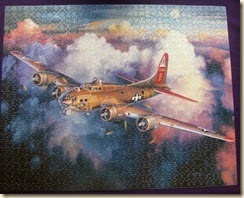
B-17 Flying FortressA friend of mine lives in Stehekin, the small wilderness town at the head of fifty-two mile long Lake Chelan. The little hideaway is accessible only by air or boat. Winters in Stehekin can be harsh…they certainly are long. My friend told me during the “off season,”when not hibernating, he passes some of his time meditating and practicing yoga. He and I are the same age, and while our winters in Western Washington are seldom harsh, they always seem interminable. But meditate? Isn’t that what you do when you awake at 1:30 a.m. and can’t go back to sleep? Yoga? I have trouble stooping to tie my shoelaces. I’ve heard that auditions for Cirque de Soleil require the applicant to perform at least intermediate level pretzel-like positions. Yoga? If I tried entry level asanas, I’d make sure my phone was set on 911 speed dial so the the local EMTs could come unknot me.  So what do I do when I look outside and the outside is fogged in, rained on, frosted over? I puzzle my way through it.

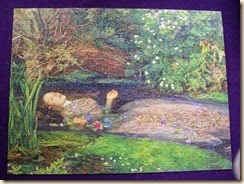
Once the demands of the holiday season are met and the bustle of Christmas has subsided, I clear off my project table, roll out the puzzle mat, and spill a thousand pieces of this year’s challenge in a heap. “The “challenge,” hopefully, is a gift from my Christmas list, one the members of my family know I’m anticipating. Dead OpheliaI allow myself the luxury of one puzzle a year: post Christmas and the first month of the new year. The only criteria are that the puzzle must be a 1,000 piece and its subjects appeal to me (I’m partial to lighthouse scenes, by the way). As my project table has many uses throughout the year, I need to free it up for subsequent use. My goal is to have the table puzzle-free by January 31.
Granted, puzzling might not be the most productive way to spend one’s free time, but it’s a great stress-reliever; puzzling reduces decision-making to its lowest common terms: the piece either fits or it doesn’t…simple as that. A bit of caution, though: puzzling is certainly addicting. I can’t pass a puzzle in progress without coming to a screeching halt, giving the layout the once over, even pausing long enough to fit in a piece. For instance folks at my mom’s Senior Center had a 6,000 piece puzzle going last spring. It was a triptych, a puzzle in three panels. For their puzzle table the Seniors had balanced a standard house door on two sawhorses. I vowed that on one of my visits, I would insert just one piece and help them out a bit. That visit finally came and a brief hour and a half later the Sr. puzzlers had one fewer piece to install.

Puzzles. They come in all shapes, sizes, number of pieces, 3-D, cardboard, wood, metal…there’s a puzzle for all tastes, ages, and personal preferences. All present a challenge (that’s why it’s called a “puzzle,” isn’t it?)…and an alternative to playing Solitaire, video games or cruising Facebook. I prepare a cup of hot tea and set to work at meeting my quota of fifty pieces per day (one I rarely achieve).

Puzzle strategies: how does one attack the puzzle at hand? Borders first, of course. Rectangles and squares, find the four corner pieces and then connect them. Color and design are important considerations. Keep the puzzle box picture handy ( just like the message imprinted on your vehicle’s side mirrors: “Objects in mirror are closer than they seem,” the seasoned puzzler knows that space in any puzzle is compressed). As each puzzle piece is unique, shapes, too, are an important consideration. 

A perfunctory study of puzzle piece nomenclature does not reveal much. The “in’s and outs” of a puzzle piece are thusly described as “inzies and outzies.” Both terms, to me, conjure up images of midriff anatomy. I prefer to call the irregular parts of a puzzle piece “tabs” for the extended parts and “bays” for the notches. Regardless of name, these puzzle piece configurations are important clues in puzzle assembly. The puzzler proceeds with all these components in play: color, design (mini-components sprout up on serving trays, in puzzle box tops, on the edges of the puzzle board…), and the configuration of tabs and bays per piece. As the puzzler proceeds toward the end, say two-thirds finished, (the puzzle becomes a teensy bit easier with each piece installed, and every new piece added provides a clue for the next), he can eliminate like-configured pieces by trying to fit them. If the piece doesn’t fit, it’s inverted to prevent rehandling the piece countless times: the sought after piece turns up through the process of elimination. Then flip the inverted pieces and press on.

Once in a while a puzzle comes along where extreme measures are called for. For example, my son-in-law whiled away a winter’s doldrums by tackling a two thousand piece puzzle, the subject of which was Vincent Van Gogh’s famous painting “ Starry Night.” The pieces were small; the pieces were all the same color, mostly starry, starry night colors. No help there, so son-in-law segregated the pieces by shape: similar tabs and bays and protrusions were accorded their own plastic bowl, seven or eight of them.When a certain configuration presented itself, the puzzler went to the right “well,”so to speak, and thusly reconstructed Van Gogh’s whirling heavens. 

This year I was gifted with a round puzzle featuring a cloud of exotic lepidoptera, butterflies that never existed in the real world. puzzling in the round“Puzzling in the round” was a first for me, and in spite of the departure from the norm, I don’t believe the circular geometry made the puzzle any more difficult. The big issue with this puzzle was mechanical: the fit of the pieces so loose that sections of the puzzle lifted up whenever a new piece was installed. One of my approaches to a puzzle is to piece together prominent scenes or subjects, set them aside, and then incorporate the finished section into the puzzle map. Because of the loose fit, I had to dismantle these islands piece by piece and reconnect them in the puzzle. Time consuming, yes, but isn’t that the point of puzzling?Jan. 9
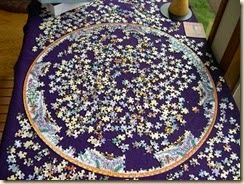
There comes a point in each puzzle project (the halfway mark ?)where I become frustrated. “I’ll never finish this thing,” I groan. Some pieces you’ve picked up so many times you can see them in your sleep. But that’s when things start to click: you begin to feel at one with the puzzle; pieces that have eluded you suddenly stand out in the crowd; and before you know it, you can see the holes at the end of the puzzle.Jan. 24

January 29th and 30th were marathon puzzling days, over 100 pieces installed each session. Mid afternoon, January 30, I slipped the last three pieces into place—finished a day early.

It’s become a tradition over the years to gift my environmentally-sensitive friend Nancy L something to puzzle on over the holidays. I spend considerable time and thought selecting  just the right puzzle, one that in her words qualifies as a “real stinker.”  I’m always disappointed on how quickly Nancy, with the help of husband Jack, assemble my puzzle gifts. Out of exasperation one year, I gave her a puzzle but held back one piece. I’d keep track of her progress by emails. One day I received a frantic message from Nancy L announcing the puzzle was finished—except for one piece, which they’d looked for high and low…even in the vacuum cleaner bag. The next day I popped the “missing” piece in an envelope and mailed it to her.

This year I found Nancy L a 1,000 piece puzzle of the Titanic. I gloated as I looked at the picture on the box: the dark hull of  the ill-fated super liner Jan. 29becalmed in the black waters of the North Sea under a starry, starry northern sky, a myriad of white dots sprinkled like grains of salt on a calm ocean, dancing and flickering amid reflections from a thousand glowing portholes. “Ah, ha,” I exclaimed, proud of my discovery…this one’s a “super stinker” for sure. I saw Nancy L less than a week later. She and Jack had already pieced the Titanic puzzle together. I’ll bet they completed the task in about the same time it took the unsinkable behemoth to slide beneath the icy waters of the North Sea and plummet to its final resting place on the  ocean floor. Next year, Nancy L, next year….just wait. I’ve got my eye on a REAL stinker this time.Jan. 30

Monday, February 16, 2015

One Thing I Know for Sure…

chicken choresIf you recall The Ripple’s last post, my environmentally-sensitive friend Nancy L stated, “Ain’t nothin’ don’t like a chicken.” The one thing I know for sure? Nancy L spoke a mouthful of truth. Today I thought I’d visit the Valley to add a bit of photo to my journalism, collect some snapshot support of the Frohnings’ mobile chicken operation. I was in luck. Sandy Frohning, the CCO (Chief Chicken Officer), just happened to be on the premises herself, feeding the flock and collecting the efforts of the hens’ labors. I snapped a shot or two while she made the rounds and gathered the eggs.all in one basket

Those who follow The Ripple know it exists solely because something’s always happening in the Valley. Or today, as it turns out,  has happened I learned when Sandy’s blue ATV putt-putted alongside. “Remember the three P’s I was telling you about the other day?”Sandy reminded me. What I had learned from our little chicken seminar was still fresh in my mind:  the three P’s of free range chicken ranching. free range flockThe job description of a good rooster, Sandy informed me was to protect, provide, and procreate. “And I’ve got a good one,” she boasted. I had shared my concern about the vulnerability of her flock which seemed easy pickings for hawks, eagles and coyotes. Which one of us was the pariah…me for broaching the threat of coyotes…Sandy for bragging on her rooster, I’m not sure. Perhaps we were equally to blame, but whatever the case,  it so happened this morning I had stumbled upon a crime scene.Big red...dead

Remember that stalwart rooster, protector of the flock, the one that worked extra shifts to keep his ladies safe, well fed, and… well, should I say, “entertained?” Apparently a marauding coyote slunk through the morning’s fog and served up Big Red for its breakfast, thus leaving the flock dynamics two P’s fewer and the bustling little hens at the mercy of  two randy roosters. As Sandy walked me to the scene of the crime, I was amazed at her calm, nonchalant acceptance of Big Red’s untimely passing. “It’s life,” she smiled, putting me in mind of Jack London’s Call of the Wild, “I just hope the two juniors can step up and follow in Big Red’s chicken feet.”

Camera in hand I stared down at a pile of feathers, feathers that would never cross that road or any road ever again.a hiccup of feathers

Friday, February 13, 2015

A Chicken Chautauqua in the Valley…

coup to go“Ain’t nothin’ don’t like a chicken,” my environmentally-sensitive friend Nancy L commented a while back when one of our chats touched on the subject of poultry. Her words are what I consider every time Gladys and I wobble by the Frohning’s sometime cornfield, presently pasture. For the last couple of months I’ve noticed a mobile chicken coop in various quarters of the field. The structure just appeared one day like a humongous portabella mushroom.  The coop with its swaybacked roof and weathered sides looks like some rustic subject painted by Andrew Wyeth. The structure rests on an old hay wagon and at the whim of those who tend the flock, can be towed to greener quadrants of the pasture.Frohning and Frohning

When this primitive chicken RV first caught my attention, it was smack dab in the middle of the pasture. Members of the flock appeared as just so many dots sprinkled around the wagon. Only the faint crow of a rooster from time to time hinted at the structure’s function.  Our Valley is home to a variety of hawks, and this time of year I see eagles nearly every day Gladys and I venture forth. On two occasions I have seen coyotes loping across the fields. “Ain’t nothin’ don’t like a chicken,” I think whenever I see that flock of fifty or so birds in a wide open field with nothing to protect them but luck and the shelter of the coop—and some of the bolder hens wander beyond the point of no return, plump meals for any predator riding the Valley air currents. “That flock is certain to dwindle,” I think every time I pass by.grounded eagles

Lately the coop has been relocated so close to the road that the flock wanders the shoulder; some even forage in Decks’ pasture across the road. As I ride along today, as if it’s an exercise in“Where’s Waldo,” I look for the coop, notice it’s been relocated at the far end of the pasture even closer to the road. I no sooner note the new location when an ATV pulls onto the asphalt, then slows as I approach. Sandy Frohning is at the wheel. She pulls up next to me, smiles and shuts down her ride. I notice she has a basket heaped high with eggs balanced on her left knee. Ah, here’s the chicken tender of the flock up close and personal. After we exchange greetings, I seize the opportunity to ask the question I’ve been longing to ask every time I pass that vulnerable covey. “Your chickens roam the wide open spaces,” I tell her, “aren’t you afraid of losing your stock to marauding hawks and eagles?” “The eagles or maybe a coyote may have taken a couple” Sandy replies, “but the highline wires provide some protection from the air and I’ve got a good rooster that keeps one eye on the skies and field. Any threat from above or below and he sounds the air raid siren, sends the flock scurrying to the shelter of the coop.”

Sandy fills me in on a good rooster’s job responsibility. “Every good rooster performs the three P’s,” she says. I have had some chicken experience of my own--as a onetime chicken rancher when I was a boy, and later here in the Valley when I rode herd on Fred Rogers, our rogue rooster. The “P” that immediately came to mind  was “poop,” the dirty reality of poultry ranching. Imagine my surprise when Sandy filled me in on the three P’s, none of which involved excrement. I learn that any good rooster on salary “Protects”: watches over his girls, warns them when danger is at hand; “Provides”: seeks out grubs, worms, other morsels and then calls the ladies to table; “Procreates”: sustains the numbers of his harem. “I’ve got a good one,” she smiles. “The young roosters only have one thing on their minds.” “Ah, yes,” I muse, “only to be young again.”

I learn Sandy gathers two and a half dozen eggs a day, all of which she sells to a local farm. “It’s the only thing making any money for us,” Sandy says. The Frohnings run a small dairy herd and, well, with milk prices as they are…. With her eye on the farm finances, she wants to double, even triple, egg production and is always on the lookout for more layers. If anyone out there in shouting distance has extra hens they’re tired of tripping over when they go out the back door, Sandy could use the surplus.

She fires up the ATV and heads back to the farm to clean the day’s clutch of eggs. Gladys and I ride off, at least one of us a bit wiser about roosters and the poultry business. A mile or so closer to home it hits me:  there was a second question I’ve been dying to ask a poultry expert. Just now I had one at hand and failed to ask it. So Sandy, if you’re reading The Ripple these days, answer me this: “Why do your chickens cross the road?”winter in the Valley

Monday, February 2, 2015

And Some You Lose…

garden journalThis year’s seed catalogs are cropping up in the daily mail. Not as many as last year—a subtle reminder from the seed companies that I need to order more seeds this season. As I thumb through their glossy pages, looking forward to this year’s garden, I’m reminded again of my garden journal, the notes I made about last year’s disappointments and order accordingly. Fool me once, fool me twice…no repeat bad experiences.

Tomatoes: Of the four new varieties I tried, three did not perform well. The first, a determinate variety called Silvery Fir Tree, aside from its frilly, fernlike leaves, won’t be welcome anywhere on the place this year. This was a “patio” tomato touted by Barbara Kingsolver in her book  Animal, Vegetable, Miracle. I’ll grant Barbara the delicate, lacy foliage but the fruit was tough and flavorless. I don’t know…maybe they just needed that Virginia heat and humidity. My brother recommended a variety called“Delicious,” a name appealing enough for a tomato, but  it was late to mature and the first to present late blight. questionable advertisingCome to think of it, I had to remove some withered vegetation in mid-July. Perhaps this was a “hothouse” variety and thrived in brother’s greenhouse, but I won’t waste my time with Delicious this season.

You can almost taste the tomatoes in the glossy pages of seed catalogs. Perhaps that’s why I took a chance on a colorful variety called Georgia Streak, an orange tomato with red streaks, or a red tomato with orange streaks; when sliced, the flesh looked like sunburst disks. I was so taken in by its professional appearance, its sheen and colorful markings that I overlooked an important clue in the name—“Georgia”—and purchased the seed, disregarding the fact its summer home was destined to be Washington…and short season Washington at that. Streak’s fruit never fully matured; the top half was tomato leather; only the bottom half was juicy enough to slice. So much for Streaking in this climate.

Peas: I’ve had amazing crops of peas here in the Valley in past years. A crop one year just keep producing until I finally cried “Uncle” and left the pea patch to play itself out. This year I had a crop failure, two varieties: garden peas and sugar snap. The vines of the former were spindly and produced poorly…enough for perhaps a half dozen meals.  The remainder barely filled a third of a gallon freezer bag.  But the garden peas bore a bumper crop compared to the sugar snaps. Just what happened with them I’m not sure. In the third of a row I planted, less than half sprouted; those that did were stunted and ratty-looking, and even though I replanted the row twice, the results were the same. Total sugar snap yield? One meager quart freezer bag, hardly enough for one meal of stir fry.

You know, I think my days as a pea farmer are over. Now that my grandson knows that peas don’t come from a tin cylinder or the supermarket freezer case and has experienced plucking peas fresh from the vine, shelling out a handful and popping them one after another into his mouth, I’m done with peas. Gimme a pea!It’s really just a matter of simple economics and time, which brings to mind that classic American garden journal, diary, chronicle, Walden, New Englander Henry David Thoreau’s treatise on simplicity and frugality. Thoreau, in an effort to streamline his life, built a rude hut on Walden Pond and became a bean farmer. Yes, beans. As Henry kept a detailed ledger of expenses, he no doubt ruled out peas in favor of beans as the most economical crop to raise. His outlay for bean seed? Three dollars, twelve and a half cents (in colonial currency). He spent six cents for pea seed.  At season’s end the gross income from Thoreau’s  nine bushel and twelve quart yield (shell beans, I assume) tallied sixteen dollars and ninety-four cents, a return of  eighty-one per cent. Of his pea crop or its profits Thoreau makes no mention.

The economics of my pea farming: five balls of pea twine @ $2.00 a ball. $10.00. Seed: garden and snap: $8.00. Labor: twining the vines, weeding, picking, shelling, preserving…. @$9.47 an hour minimum wage. Hmmmm…. A four pound bag of shelled, frozen peas at Costco: capital outlay approximately $6.00. Even a pea-brained gardener can see the bottom line in this scenario.

Lima Beans: or, if you’re a southerner, “butterbeans.” I’ve fancied lima beans since childhood even though as a young boy I once overindulged on a meal of them causing me to bloat up like some ruminant on fresh, sweet hay.lima bean crop I can vaguely remember my parents holding me down to prevent my drifting to the ceiling like a methane inflated balloon. Lima beans with ham; lima beans with ham hocks; lima beans in soup; lima beans simmered in butter…I was determined to raise a crop in the backyard garden. Dr. Samuel Johnson once said of a man who married a second time, “It’s the triumph of hope over experience.” And so it was with me and lima beans. I tried Fordhook limas, bush variety, for two or three seasons and despite my efforts the vines sprouted only a few empty pods. Next I tried the pole variety although it’s not that easy to find seed. More success with these, but limas don’t perform well in our short season garden. What crop I did raise wasn’t ready until early October and when the beans should have been coming on, the cool nights of fall caused the new blossoms to abort. I also discovered lima beans need a warmer soil temperature to germinate, perhaps four to five degrees higher than regular garden beans. I had my best results starting the seed indoors and then transplanting the starts in mid-June. From this year’s single bean teepee I shelled out perhaps enough for two meals. The rest I dried…maybe enough to complement a ham hock…and make that a small one. So until we experience more global warming here in the Pacific Northwest, I’m finished with lima beans here. Until, that is, my next trip to Costco.

Zucchini: Yes, zucchini…No, you didn’t misread. Raising zucchini a disappointment? Concerning zucchini, disappointment usually occurs when the gardener runs out of recipients to take the excess tonnage off his hands. This season my foolproof  plan to bolster my donations to the local food bank was to plant more of this green squash machine. And I did: a dozen plants, enough potential to feed an entire city block plus a couple of high rise condominiums. I planted the dozen in a sandy section of the garden, just beyond the reach of the garden hose. The zucchini did not like it there, went on strike, refused to ramp up production, yielded only enough for a couple batches of zucchini bread and a few stir frys. Yes, Virginia, it is possible to have zucchini failure. So I’ll back off to three plants this year, plant them in in heavy soil back in the realms of irrigation.

One more tally in this year’s loss column--more a concern than a disappointment. In late August the garden was plagued by a severe infestation of  cucumber beetles. The horde made doilies of the bean leaves, gnawed craters in the remaining pods, appropriated the dahlias and zinnias,  and riddled their blossoms with holes. Some blooms were host to a half dozen or more beetles.  Not one colorful bouquet from the patch, the beetles saw to that. And I’m nervous about a repeat performance this season.

A few days back I took a walk in the Valley. On the shoulder of the road I spied one brave dandelion stretching its sunny face toward the sun. Two sunspots appeared on its friendly surface. A closer look revealed a pollen-laden native bee in the company of, you guessed it, a cucumber beetle. That’s one sign of spring I can do without.