Search This Blog

Tuesday, July 23, 2019

On the Loose in the Valley...


Usually it's midday when Gladys and I take our morning exercise. Midsummer now, the days hotter, so today I decided to take advantage of the cool morning and still air (Gladys hates a headwind). Backing into the Swiss Hall parking lot, I was surprised to see the environmentally sensitive Nancy L chatting with a woman on the Hall's back porch. Out for her walk, I thought, ever vigilant the Valley isn't filling up with trash. As I was offloading Gladys, Nancy L wandered over to share news that four of Werkhovens' calves had escaped and were out and about somewhere in the Valley. "They found one," she said, " but three are still on the loose." I looked across the field to where a band of green stood out above the pasture grass. This summer's corn crop. As I pedaled off, I told Nancy I hoped the calves weren't out there somewhere in the corn.

The corn stalks are chest high or taller and put in me in mind of our trip to the mid-west ten years ago. We had left the main drag to visit South Dakota's Badlands National Park. At one of the "scenic viewpoints" we looked out over what looked like miles and miles of humongous inverted egg cartons. Mountains of mounds and hillocks as far as the eye could see. A sightseer who shared the view with us remarked: "Helluva place to lose a cow." I'm sure those words had been spoken at that site countless times, but they were original to me, and I thought about them again, this time in the context of acres of corn and three stray calves.

On down the road a ways I was glad to see a fellow and three girls insinuating themselves between three spotted calves and the verdant cornstalks. The lost had been found and were now being chaperoned back to the calf pens. "Ah, the escapees," I told the cowherds as I pedaled by. "Just glad they weren't in the corn," the man replied.

As we pedaled by the stands of corn along the river I wondered what course of action Werkhovens might take in the future should more wayward stock wander into the corn. Aerial surveillance? A drone perhaps? It seems like those high tech whirlybirds are everywhere these days. (A couple Saturdays ago a drone was flitting back and forth over the heads of a wedding party at the event venue south of our slim acre; a wedding photographer had taken his art airborne.)

On the return leg I came upon Steve Werkhoven and the three young lady cowherds by the dairy milk house and stopped to fill in the rest of the story. There are many a head of calves at the dairy, and I was curious how they knew some of the herd were missing. One of the girls said someone had seen them running along the road and then out in Decks' hayfield. They were able to corral one but the other three escaped and disappeared. It was then I learned my thoughts had dovetailed into calf recovery. Steve said Decks had a drone, did a flyover of the area, and located the calves sauntering along the riverbank. All that remained was to herd the prodigal bovines back to the calf stalls. Werkhoven told me the dairy had seven hundred acres planted in corn. " A drone might be a good investment,"I told him. "Yeah," he replied, "They usually just hang around the calf barns though," and went on to say they'd have wandered home sometime anyway.


Maybe so, I thought, yet the dairy folks had had to leave their morning routines to retrieve them, hadn't they? Without the aerial reconnaissance they might still be searching. And that seven hundred acres is one helluva big corn maze....

Monday, July 22, 2019

Grammy...Or Charlie?...


It's hard to believe Kelly Bolles' great horticultural experiment, trifling with truffles, (Trifling for Truffles or there's a Fungus Among us in the Valley), is now in its eighth year. I think about his project and those exotic 'shrooms every time Gladys and I huff and puff our way past the oak and hazelnut grove especially planted to foster a crop of the gourmet fungi. Five years, Kelly told me, the earliest he could expect any sort of crop. "If I could just find a truffle like this, " Kelly grinned, configuring his fingers in the shape of a softball, "I'd have it made." Or something to that effect, in other words a gourmet gold nugget....

Whenever I see Kelly these days, I ask for an update. As of this post the Valley's sometime truffle king has yet to unearth a single gnarly corm. I'm no expert on truffle horticulture, certainly haven't done the research Kelly has on the crop, which he geared to the Pacific Northwest truffle industry that's well established in Oregon. My knowledge of the elusive fungi is limited to European truffles, a subject that crops up every so often in the news. For centuries in truffle country, especially France, truffle foragers have used the keen olfactory ability of pigs to locate and root out the treasured mushrooms. In keeping with Old Country tradition, come potential harvest time, Bolles purchased a pair of porcine truffle seekers, but I wonder if Kelly's new help might have put his fungal venture in jeopardy.

Here's where the Valley truffle adventure becomes more interesting. Pigs love truffles just as much as the French gourmand. Once a truffle hog roots up a prize, the pig's handler must pounce on the find immediately before his assistant can scarf it down. I'm sure Kelly was aware a truffle sniffer could and would down the crop if the handler didn't quickly intervene. Perhaps Kelly's research focused on the growing of truffles more than the harvesting of them. Not sure about that, but after the fact, when the pigs were hired on, Bolles learned that a potential truffle hunter has to be trained in the art, training that should begin at the piglet age. Kelly's two pigs? Both mature hogs. And apparently you can't teach an old hog new tricks.

You might say the pocine pair are now a Valley fixture, and as you drive the Lower Loop Road south of Werkhoven corner and happen to see afield what appear to be two large dogs in the vicinity of Kelly's truffle grove, those'd be Grammy and Charlie. I caught them unaware the other day and thought I'd snap a photo, but when I approached, Grammy...or Charlie was having none of it, snorted and waddled briskly off, presenting only his or her porkly backside to the camera.

"How are Grammy and Charlie these days?" I asked Kelly last fall when our paths crossed.  It was flood season and he was worried about them. "They weigh nearly four hundred pounds apiece," he told me. "If we have a flood, I can't pick 'em up...they'll drown. I need to build a critter pad so they can escape should it flood." He has yet to build a higher ground refuge but as it's not flood season, I don't think mounding a pig escape is Kelly's priority.

When I mentioned bacon, pork chops, and cracklin's, Kelly laughed and shook his head. As we pet owners know, naming an animal elevates its status to that of pet, and it appears Grammy and Charlie are now part of the Bolles's household, not likely to become pulled pork or pan fried side meat. But Kelly's always looking for an angle: "Maybe I should train and sell truffle dogs," he chuckled,  "There's real money in that..." as a trained truffle dog has little interest in downing a pricey mushroom. While he's sharing this with me, I'm thinking about Grammy and Charlie, the way they've bulked up, and how I frequently see them rooting about in the truffle grove. Perhaps they're finding more there than cover and shade?

Meanwhile when fall rolls around, Kelly has hazelnuts for sale and even extends the courtesy of a stock tank in which one can dunk his hazelnuts to see which sink or float (the floaters contain no meat). I'll close this post by sharing a question I put to Kelly one day: "How can you tell which is Grammy and which is Charlie; their markings are the same?" "Charlie has tusks," he said,... good information to have the next time I get close enough to snap another photo.


Wednesday, July 3, 2019

The Glorious Fourth...


The Fourth of July was the memory of a new republic, a bloody babe of destiny, waiting to be filled with soul.

Ross Lockridge, Jr.                                           
Raintree County                                         
                                                                                             

To look at the sweet corn you wouldn't believe it. Independence Day, 2019, and the corn is yellow and stunted, barely ankle high. Looks like"Knee high by the Fourth of July" will have to wait for the next corn season. I tilled up the first planting which yielded a meagerly dozen sprouts out of two rows. The second planting, while well-sprouted, lacks the robust growth corn usually experiences this time of year. But please excuse the corniness. The subject of this post concerns the 243rd birthday of this our Grand Republic.

This Glorious Fourth, I'll spend like last year's: listening to Sousa marches and the patriotic songs rendered by the forceful chorus of the Mormon Tabernacle Choir from their "Spirit of America" CD. The pyrotechnics I'll leave to the younger, more adventuresome set; those days of crump, crackle, and boom I've left behind, thankfully with all fingers and limbs intact, hearing only slightly diminished. I'll miss, however, the homemade ice cream and butterscotch brownies.

In honor of the day perhaps I should revisit the Declaration of Independence, brush up on the Constitution of the United States, read some of the fine print. Or perhaps a bit of Thomas Paine.... (Seems to me the pamphleteer's messages are currently--and sadly--foreign to the powers that be.)

But no thanks. On this celebratory day I can't think of a more patriotic thing to do than pull my favorite novel from the bookshelf, the only novel this confirmed reader has read twice, flip through the pages to my favorite passages (my copy bristles with sticky notes), and revisit the grand panoply of our Great Republic in the latter half of the 19th Century.

Raintree County is a sprawling novel. And at times a brawling novel. (The manuscript Lockridge delivered to Scribner's publishing weighed twenty pounds.) It covers a tumultuous epoch of our country's history, the britches bustin' period spanning the Clay/Polk presidential election of 1844 to  1892, a half decade that saw the Westward movement and the closing of the frontier, the Civil War and the Emancipation Proclamation, and the transcontinental linking of our infant railroad system, "binding ocean to ocean in bands of steel." The fulcrum of the story line is July Fourth, 1892, and the slate of celebratory events scheduled for the day. The story begins with protagonist Johnny Shawnessy preparing to participate in the festivities. Events of the day trigger flashbacks that skip the story back and forth across five decades of history including seven memorable July Fourths. Though successive chapters might record events decades apart, the ending sentence, each incomplete, is skillfully linked to the beginning sentence of the next. This device, though delightful, makes the novel a challenge to read. Every Glorious Fourth I consider it a patriotic duty to revisit Lockridge's epic novel and thus once again...

happy birthday to our Grand Republic. May it thrive and prevail as a safer...and more to the point, saner beacon for the world.


Wednesday, June 26, 2019

HARD HAT AREA...


Are you familiar with the American folklore hero John Henry? A few days back I was reminded of that legendary steel drivin' man. A rhythmic "clang, clang, clang" from the Valley gave me a welcome pause from the hoe handle. Metal on metal it was. A persistent metallic echo you could almost feel through your feet, beating time as if it were the percussion section for a gandy dancer's chant. "Who or what is pounding away out there?" I wondered and almost immediately remembered an email I'd received from Matt Beebe, The Ripple's down Valley reporter with an update on the Bridge 155 replacement project which began in April (after a two week delay) and is slated for completion by January 13, 2020.

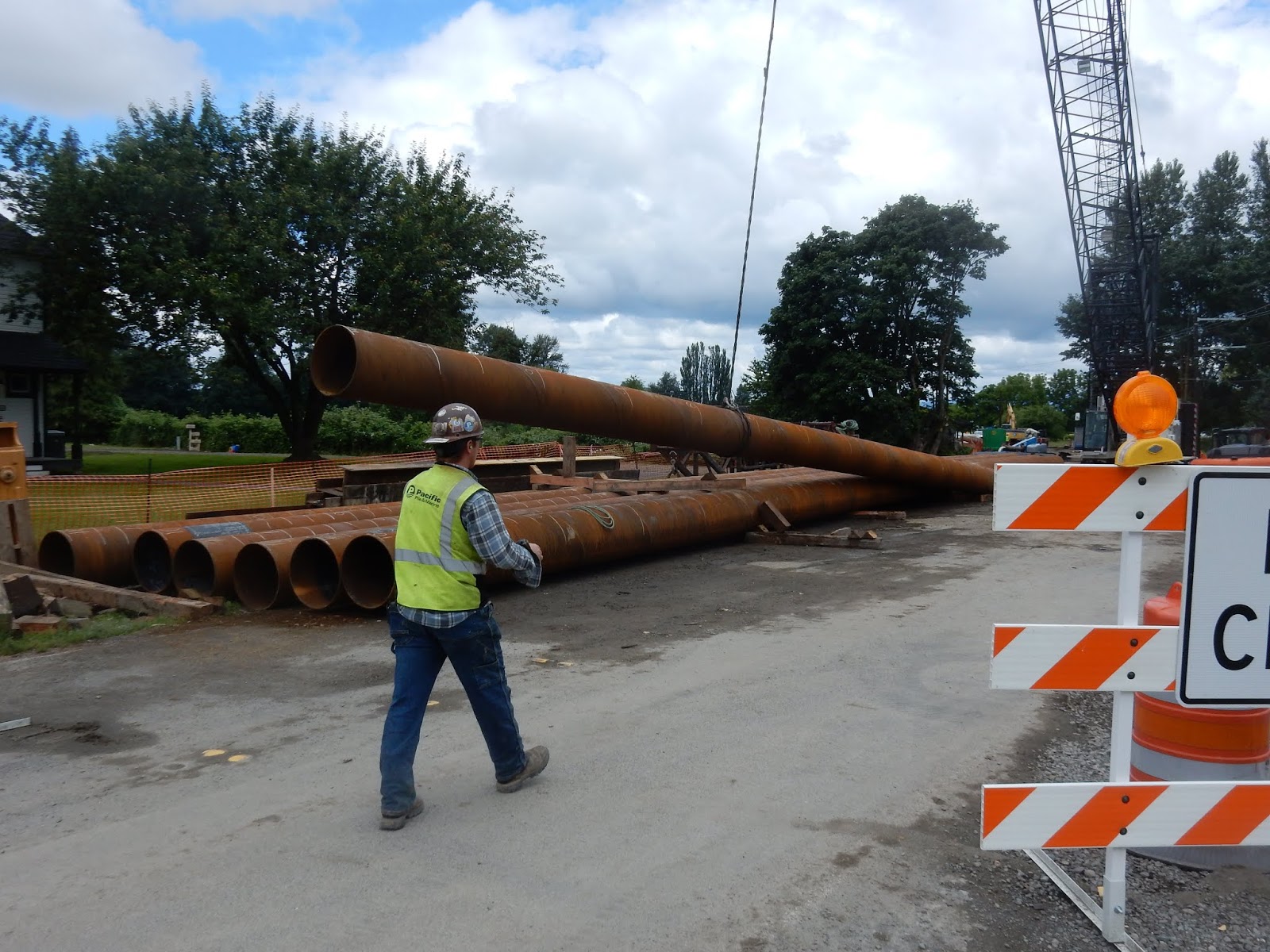
According to Reporter Beebe after the old bridge is demolished, the County's contractors will set fifty-two metal pilings across Riley Slough, deck support for the new bridge. Each piling will be driven fifty feet down to Valley bedrock (as per current County seismic code, I'm sure). The "clang, clang, clang?" A pile driver rending the peaceful Valley air with an irritating cacophony. The construction crew will set the pilings on the north and south banks of Riley but as the slough is a "salmon" fishway (according to Matt, the last salmon he saw in Riley Slough was in 1985 and that at his childhood residence back up Ben Howard Road) workers will defer setting pilings in the watercourse proper until sometime in July--after spawning season, so as to disturb for now, Matt shared, "only the frogs and salamanders."

More news. The environmentally sensitive Nancy L, out for a walk in the Valley, watched in amazement as a truck pulling "the longest trailer I ever saw" hauling four steel pilings slalomed its way to the construction site. We both wonder still how the truck, pilings in tow, was able to negotiate the right angle curves on the upper Loop road. Nancy L suggested I check out the construction site: "There's some mighty big equipment there," she said. So today Gladys--an amazing bit of equipment herself--and I ventured out to gather some news....


Our ride to the construction site was one of contending fragrances...olfactory ambivalence, if you will. As we rolled by Broers' berry fields, the midday sun brought forth the sweet, almost cloying, smell of ripe strawberries. But strawberry fields don't last forever and further down the road Gladys nearly balked as we happened upon Andy Werkoven, boot tops awash in verdant froth and foam gushing from one of the poo poo sprinkler valves. Strawberries and liquid poo, pungent enough to clear the clogged sinuses of an elephant.


We grind to a stop past the "road closed" sign and find ourselves in the presence of "some mighty big equipment." In the shade of a large crane a pair of hardhats were chokering up one of those huge pilings. The more diminutive of the two walked my way. From the look of his battered headgear, I could tell he'd been around the construction trade for some time. "How long are those pipes?" I asked. "Shorty" shot me a proud smile: "103 feet," as if to boast that size does make a difference. (I estimated the diameter of each about eighteen inches.) I shot a few photos and then crossed the lawn of the old Victorian two story to take more shots of the work in progress in and around the slough. A couple of the pilings protruded from their fifty foot bedrock pillows. I noticed workers had installed a miniature caisson to keep the sluggish slough waters at bay and thought: " Frogs, salamanders, and salmon, watch out."


My photo op concluded when Shorty, gesturing toward a tilted up, huge piling, shooed me away from the danger zone. "Wouldn't want you to be on the news," he explained, referencing, I'm sure, some of the crane accidents in the news of late. "I've seen it happen, and it's not pretty."

After Shorty herded me out of harm's way, I asked him if I could wait until the bridge was finished so Gladys and I could continue our ride. "You'd be pretty hungry by then," he chuckled.  I went on to ask about the project timeline, if the work was proceeding as scheduled. The answer? Shorty shrugged his shoulders. I followed up with, "How about cost overruns?" "You have a good day," he said, striding briskly toward the hard hat area. The interview was over.

 And for now that's the news from the Hard Hat area....

Monday, April 22, 2019

The GOOD Earth...


For a few minutes yesterday I watched a queen bumblebee nest questing. Like a small bomber she was flying at treetop level, coursing back and forth over the ground. She had overwintered in some protected place and her task at hand was to find a suitable nest site to raise a new generation of her kind. Flying low next to my feet, I watched her investigate two abandoned vole holes along the fenceline. She disappeared into each for a few seconds only to emerge a short time later, having decided, I surmised, the site lacked the specs necessary for a suitable home. She flew on into the neighbor's pasture, disappeared in the high grass and though I waited for her questing to resume, I never saw her again.

Today is Earth Day, the forty-ninth anniversary, if memory serves. I was around back then for the very first one, teaching at the time in a small high school in the northern part of the state. I remember the day was spent free of traditional instruction. Students instead attended short presentations by local naturalists and members of the U.S. Forest Service. It was a day well spent, raising, if not students' awareness, certainly their appreciation of the pristine wilderness and natural beauty that was so much a part of their daily lives.

Something is killing my bees. My bees used to thrive here on our slim acre. Now winter after winter I lose most of my hives and come spring have to replace them. Other beekeepers are suffering the same plight. Some lose all their hives. Others, most of them. I know for a fact certain species of butterflies, due to habitat destruction, are no longer found in their former haunts. These may seem minor issues to some, but to me they mean something is wrong out there, something is awry on the "Big Blue Marble," our planet Earth, the only one that keeps us--thanks to gravity--grounded. Not only "the times, they are a' changin'," but our planet is a'changin', too. And I believe we, as a species, are significant players in this change.

Whether you accept that Homo sapiens is complicit in climate change and global warming or assume the cavalier attitude that shifting weather patterns, the receding glaciers and polar ice caps are natural cycles, have occurred since the beginning of time, are to be expected, the natural course of things...something with which we as a fragile species have to deal, set aside a moment or two today away from the distraction of your technology and do one or more of the following:

Examine the architecture of a flower. Even a dandelion is a miracle. No need to hug a tree. Just look at one. And not just "look" at it, but "see"it as a living thing that shares this planet with you. Note the branches, how they grow, the leaves, the needles, its bark. A tree is a "territorial view" in and of itself. Consider a lake, a river, stream, creek, puddle or raindrop as more than just water, but as an essential component of life, your life and your children's, and that of all living things, a precious and irreplaceable commodity. Take note of the creatures of the air: birds, insects in flight...commune with a cloud. All are of this planet, all play a role in the grand scheme that is nature.

Or consider that bumblebee queen, her quest to propagate future generations of her kind, her offspring and the offspring of their offspring, insure the survival and perpetuation of her species. Her Earth is our one and only Earth. A healthy planet is a legacy for her children--and ours. An astronaut viewing Earth through his space capsule window covered the small, blue orb with his thumb and thought, "Everything I know from my life lies there under my thumb." Words to think about on this Earth Day, 2019.

Post script: Or as couched by a real poet:

                                    The World is too much with us; late and soon,
                                     Getting and spending we lay waste our powers;
                                     Little we see in nature that is ours;
                                     We have given our hearts away, a sordid boon!
                                     This Sea that bares her bosom to the moon,
                                     The winds that will be howling at all hours,
                                     And are up-gathered now like sleeping flowers,
                                     For this, for everything, we are out of tune;
                                     It moves us not.--Great God! I'd rather be
                                     A Pagan suckled in a creed outworn;
                                     So might I, standing on this pleasant lea,
                                     Have glimpses that would make me less forlorn;
                                     Have sight of Proteus rising from the sea;
                                     Or hear old Triton blow his wreathed horn.

                                                                                   William Wordsworth, 1807


Saturday, April 13, 2019

Gladys and I Say our Goodbyes...


The wheels of County Works grind slowly, but grind they do. One day Kevin Olson arrived home to find flagged survey stakes at the stoop of his rustic cabin on the banks of Riley Slough. Yes, it was four years ago Kevin learned that Bridge 155 over Riley Slough was scheduled to be replaced. A lot of water has passed under Bridge 155 since then. Kevin and his wife, not wanting a speedway nearly on their doorstep, moved somewhere up Woods Creek a year ago. The County has compensated owner Ginger Mullendore for the loss of her property. Then County Councilman Dave Sommers who met with Kevin, Ginger, and The Ripple (A Meeting at Bridge 155) about the project, (a meeting that accomplished nothing as far as mitigating the proposed shift west of the bridge approach), is now 5th County Executive. One of our stately Valley maple trees standing in the way of progress is now a heap of firewood rounds. In its stead a power pole now supports temporary power lines. The surveys are done, detour signage is posted and actual demolition of old Bridge 155 is scheduled to begin Monday, 4/15/2019 (tax day, note the irony?). Completion date: 1/30/2020 (wonder what Vegas odds are for that to happen?). In the interim, Valley commuters will detour via the Lower Loop Road. New scenery for that traffic, yes, but certainly an aggravation for the resident locals adjacent to the new route, especially the Werkhoven Dairy, making this coming winter one of discontent for their dairy cows. (Andy Werkhoven's sentiment: "I wish the County'd post 'local access only' signs.")


Yesterday Gladys and I pedaled out to the old bridge to say our farewells. A fleet of PUD rigs were on scene. A flagger motioned us around two bucket trucks, the work stations of both full of linemen working on the new power configuration. We stopped at the north bridge approach where I wandered among the spray painted hieroglyphics on the pavement to record the old bridge surface one last time. And for one last time Gladys and I pedaled across.
We pulled up alongside two PUD surveyors carrying their transits, levels, and grade rods. "I can't tell you how many times I've ridden across this bridge over the years," I share. One replied,"You should see what it looks like underneath--scary!" "Tell me about it," I said. "A few years back a pair of inspectors let me accompany them beneath for its biennial inspection" (Crossing over in the Valley: the Abridged Edition). At the south approach I stopped Gladys by the carcass of the newly felled maple tree and recorded the old bridge from that angle.


My photography session over, I mounted up and as we leisurely pedaled by the two surveyors, I told the one holding the grade rod," You know what was the scariest part about being under there? Seeing those trolls!" He grinned and shook his head....


"Trip, trap. Trip, trap. Trip, trap." Who's that trip trapping across my bridge!"


"Hush, you hairy headed thing. It's just the County. They've come to replace your roof."


Thursday, February 28, 2019

Spring calves: from the Valley Archives...


I'm going out to fetch the little calf
That's standing by the mother. It's so young
It totters when she licks it with her tongue.
I shan't be gone long.--You come too.

                                   The Pasture
                                    Robert Frost

A serious case of cabin fever due to an unusual snow event here in the Valley this month has kept the editor housebound for weeks. Except for a patchwork of white, plowed and shoveled piles and shaded areas, the snow is melting into memory. But it's a slow melting, a lingering longer than I can remember. An abnormal residual: a couple days of delight and then the rains usually wash the novelty away. I'm tired of snow, tired of shoveling snow, tired of scraping snow, tired of driving in snow, tired of tromping in the snow to and fro from house to chicken coop and back, tired of looking at a cold, white landscape of snow. Christmas, when we needed the white stuff, has long passed and with the vernal equinox just a scant three weeks away, a winter wonderland is the farthest thing from my mind.

Now that the roads are clear and dry, it's nice to get out in the Valley again, shake the kinks out of shanks' mare, and, as I've heard phrased somewhere, blow the stink off oneself... walk a furlong or two.

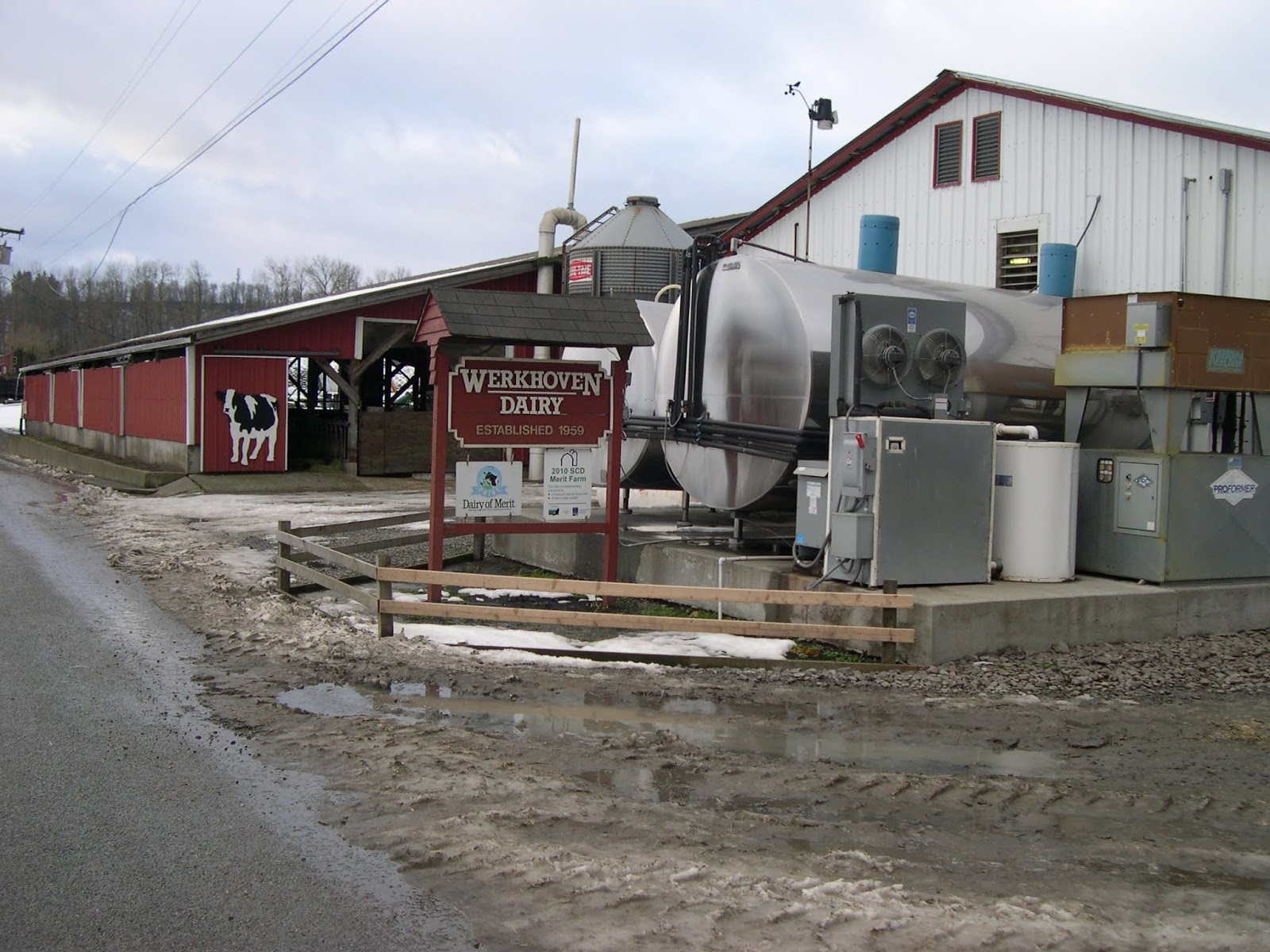
Today I turned at Sargent Road and strolled by Werkhovens' dairy barn where a regiment of black and whites, up to their noses in fresh hay, were stoking their cuds, a veritable milky way of contentment. At that moment an ATV towing a trailer rolled up, loaded to the sideboards with calf bottles.  "Lunch time?" I asked the bundled up young woman at the helm. "It's been a long time since breakfast,"she laughed. As she and another young lady prepared to stuff the bottles in the plastic sconces attached to the pens, I left them to their work and shuffled off. It was about my lunchtime, too.


I paused to watch the calves. From all appearances they seemed an aggregate of ears, noses and spindly legs, putting me in mind of the word "hobbledehoy" which Webster's gives as "an awkward, gawky youth." It's a miracle, I thought, that they ever grow into their bodies. As I thought about their innocence and vulnerability a dark memory surfaced. Years ago a troubled young man with a twisted spirit walked among the calf pens at night and bludgeoned several occupants to death with a baseball bat. Authorities apprehended the young man, and some small justice was served I believe, but as I watched the young woman and her assistant's careful tending of the calves, I thought of the heartache and pain the Werkhovens must have experienced at the sight of the dead innocents they were unable to shelter and protect.


As I trudged toward lunch, my thoughts turned to Pasado's Safe Haven, our local animal rescue organization established after a pet donkey named Pasado was bludgeoned to death in the manner of Werkhovens' calves. Some years back when I discovered a feral cat and her kittens were residing in our woodshed, I called Pasado's Safe haven, but because no one was using the kittens for batting practice, they said my cat problem was beyond their jurisdiction.