Search This Blog

Saturday, October 31, 2015

Maxing out the Garden...

For years I've thought about growing one of those huge pumpkins, had visions of it ballooning up in the pumpkin patch like a harvest moon. So why haven't I? One reason: I don't own a tractor with a bucket loader, would have no way to harvest the thing. After all, record breaking pumpkins can easily top half a ton. (This year's record: 2,145.5 pounds grown by a gardener in Wisconsin.) Every year the season's winner tops the previous by two or three hundred pounds, it seems. This year to impress the grandson, I  thought I'd give it a try. I could always remove the behemoth from the garden in chunks if I had to, take an ax to it, slice it up like I was flensing slabs of blubber off a whale.

I planted two varieties: Atlantic Dill and Big Max. As a backup, just in case the big gourds failed to produce, I planted my old standby variety: Connecticut Field which year after year always yields a crop for Halloween.There is a science to raising record breaking "tonnage" pumpkins, techniques like spritzing the vines with milk, erecting shades over the fruit to protect it from the weather, and before the gourd is too big to handle, placing it on a solid base so it won't sink into the soil. All competitors, however, seem to agree on one point: all fruit should be removed from the vine except for one, that special gourd into which you channel all your gardening karma, your hopes, your dreams of pumpkin glory, that one truly fat boy that will not only tip the scales but hopefully break them. As I'm just your ordinary gardener, no scientist or horticultural genius--and no owner of a front end loader--I set my sights on a less lofty goal: a pumpkin the grandson would exclaim, "Oh! Wow!"when he saw it.

Not long into the growing season a Big Max showed promise, and I set about lopping off all subsequent fruit from the vine. It wasn't long until the pumpkin showed above the leaves, squatting in the patch like an orange boulder left behind by a receding glacier. At season's end I had the largest pumpkin I had ever grown on the place. I had no means to weigh it, could hardly budge the thing, but I compared mine to those on sale at Fred Meyer's, plump teasers scattered around and about the mountain of pumpkins guarding the east entrance. My Max must surely tip the scales in the 140-150 pound range which explains why I had a devil of a time rolling it into the wheelbarrow and transporting it to the deck where its fate has yet to be determined.

This time of year pumpkin flavors everything. And pumpkin pie season is fast approaching. I wonder how many potential pumpkin pies my grandson Atticus is sitting on?
Pumpkin lattes? Pumpkin bread? Pumpkin cookies? Pumpkin soup? Baked pumpkin seeds seasoned with garlic salt? Yes, its one big pumpkin, but considering the world's largest pumpkin pie weighed 3,699 pounds, was twenty feet in diameter (9/25/2010 at the New Bremen Pumpkinfest, New Bremen, Ohio), I doubt my Big Max would supply one thin slice, hardly a mouthful.


Saturday, October 24, 2015

“Mush”melon…

two halves don't make a wholeGrandpa Mike’s term for “muskmelon,” (“cantaloupe” to melon lovers). English was not Grandpa’s mother tongue so I’m not sure if his native Hungarian made “musk” into “mush,” but I do know the fruit he brought home from “the A &P” always had a mushy texture. Grandpa Mike not only was a fancier of melons, but a bargain hunter as well, and the casaba, honeydew, or cantaloupe he purchased were always just a half dozen hours away from the compost heap. If the stem end of the melon lacked a mold blossom, the fruit was not likely to end up in Grandpa’s shopping cart. Come to think of it, perhaps Grandpa Mike actually meant “mush”melon: that was pretty much the melon’s condition when he lifted it from the shopping bag.

The experienced Pacific Northwest gardener knows melon cultivation is a fruitless (excuse the pun) enterprise; our short growing seasons aren’t melon friendly.To set fruit, melon vines require warm nights, considerable sunshine and soil heat. A  greenhouse environment might uncork a few melons but no such luck in the northwest garden proper. A season or two ago in a sunlight friendly section of the garden I set out a half dozen cantaloupe plants in green plastic mulch. The result? Plenty of healthy vines and a sizeable bouquet of pale yellow, star-like blossoms, but even with an abundance of honeybee pollinators, not a single flower set fruit. Imagine my surprise then this summer to find a softball-sized cantaloupe squatting beneath our garden wagon, a twofold surprise: first, that one grew to maturity here; second, that I harvested a melon at all… because I never planted a single seed.

The south side of our house is an excellent place for heat-loving vegetables and to take advantage of the southern exposure, I’ve placed four whisky barrel halves for planters. I’ve grown corn, okra, tomatoes and eggplant successfully (the okra? I might be stretching things a bit, but I did harvest enough pods to make one meal of Shreveport gumbo). Eggplant grows very well in my sunshiny south location, and each summer I’ve reserved a pair of eggplants for each of the first two barrels; however, if I didn’t amend the soil from my compost heap each spring, this post would never have been written. Soon after I transplanted my eggplant pair in the first barrel, I noticed some alien plant making itself at home between the eggplants. Its signature pair of oval-shaped primary leaves signaled some variety of squash: zucchini maybe, or pumpkin. My curiosity piqued, I decided not to yank the “weed,” but give it a chance to reveal its identity. Besides, the eggplant didn’t seem to mind the company. 

A month went by before I saw the first telltale blossom, pale yellow, star-like. Too pale for a cucumber blossom; too small for squash or pumpkin…some sort of melon certainly, but I wasn’t sure if the vine was watermelon or a “mushie.” The vine made itself at home, twining around the eggplants, threading  itself among the collards (none of which I planted either), trailing down the barrel staves and creeping onto the driveway--at which point I frequently had to redirect its forward progress.

As the summer moved forward—the vine was flowering heavily now—I checked the blossoms. Both male and female bloomed along the vine, but as in my former attempts, nothing set; the flowers withered, dropped off. The eggplant set and we had our first eggplant casserole of the season but not so much as a nubbin of a melon anywhere. Sometime late in August I stopped checking. A couple weeks later I yanked out the vine and to my surprise, bumping along at the end of it was the softball-sized melon. Though it was not even large enough to be a “personal melon”—as the produce folks in the grocery stores call them--I stripped it from the vine, and set it aside by its eggplant buddies. A week or so later, more out of curiosity than anticipation, I took the thing to the kitchen and sliced it in half.

Excepting its doll house size, the inside of this little cutie was melon perfect: the seed mass full of mature seeds, the flesh soft, salmon colored, and sweetly flavored. Half the melon satisfied my fruit requirement for each breakfast. I savored one half per meal, one spoonful at a time. Six mouthfuls each—I counted them.bite size melon (2)

Tuesday, October 6, 2015

A Meeting at Bridge 155

Ginger M., Dave Somers, Kevin OlsonSuppose you wake up one morning or come home from work, say, and find your lawn staked out almost to your front doorstep? Those orange stakes signal your life is about to change. That’s the predicament in which Kevin Olson and Vicky Olson found themselves this past week. I posted about the Olsons’ situation after a chance meeting with Kevin in the produce section of Fred Meyers (“Upgrades Planned for Tualco Valley Speedway,” 7/18) when he told me about the County’s intent to replace Bridge 155 over Riley Slough. Until last week the County’s project was just a concept on twenty-seven pages of paper with cost projections, timelines, numbers and measurements, facts themselves worthy of concern for the Olsons.encroachment But seeing those garish orange stakes, the physical manifestation of encroachment on life and property, really bring home the stark facts of the matter. I know: we’ve had stakes near and on our property, and they’re wooden slivers that fester your peace of mind.

I’m standing by the Olsons’ home on the north side of Bridge 155  on the upper Loop Road. County district five councilman and Council Chair Dave Somers has set aside time to meet with Kevin to discuss the County’s proposed bridge replacement project. Kevin has invited The Ripple to attend the meeting.

It’s an Indian summer day: blue sky, shafts of morning sunlight filter through the maple trees across the road. Except for an occasional vehicle passing by, the quiet of Riley Slough soothes. Kevin’s rustic cottage complements the pastoral setting, plank siding, unpainted, the place nearly picture puzzle perfect. Whenever Gladys and I roll by, the coziness of this little cottage nestled on the bank of Riley Slough impresses us. Primroses in the window boxes announce spring; colorful hanging baskets accent the summer; the lawns always kempt and well-tended.A homey touch And so out of place now are those threatening day-glo orange stakes and surveyor’s figures splashed on the cement drive in front of the barn.

Councilman Somers, escorted by property owner Ginger Mullendore, strolls up the road to meet us...a half hour late…bad accident on Highway 2. Dave is soft-spoken, a good listener.Surveyor graffiti The fact he’s not wearing a tie and arrives on foot instead of rolling up in an “XMT” County vehicle puts us at ease. Dave is here to address a constituent’s concern, to assess the issue up close and personal. The meeting, necessarily, is one-sided: Somers is here to listen, gather information, and see what he can—if anything-- do to help. Kevin has done his research, asks pertinent questions he’d like answered, issues he’d like explained. Of paramount concern is the County’s right-of-way. Kevin believes it’s twenty feet from centerline; County claims thirty feet. Dave says rights-of-way vary, from twenty to thirty feet depending on the locale. He’ll check it out and asks if the County has contacted Ginger about buying the property the project would claim (they haven’t). new right-of-wayNext question: average daily traffic (ADT). Kevin claims the ADT figures are too high, would like to know where the counters were placed and the dates. If the bridge replacement was safety driven, The Ripple wanted to know if structure integrity was the County’s concern or was it the issue of a blind corner at the north bridge approach? (Seems a misuse of funds If the latter is the case: only one accident has occurred in the vicinity, back in 2007…and that incident south of the bridge.) Somers shared that the County is moving forward to replace its wooden bridges (#155 was built in the 1930’s). Kevin asks a funding question: to qualify for Federal funding (the current administration has allocated funds for states to repair/replace failing highway infrastructure) are there certain parameters to which states must adhere before federal funding is forthcoming? In cases involving federal funds, Somers believed states and counties had to share project costs and match funding. The price of the project? 4.4 million dollars. I tell Dave if St. Patrick’s Cathedral in New York City could be renovated for 3 million, it seems that Bridge 155 could be totally refurbished for far less than the 4 million price tag of a replacement—and the Olsons could keep their cottage and not have their lives turned upside down.

We pointed to the “Salmon Crossing” sign at the south end of the bridge, another point Kevin discussed with the County engineers. Their response: “Oh, we mitigate those issues all the time.” If County engineers are so adept at mitigation, we wondered, why couldn’t they “mitigate” the new bridge corridor to the east instead of the west? That way no homes or structures would be impacted by the project.Sufficient for the Valley Or repair the undercarriage of #155, which, by the way, engineers have determined currently can support forty tons safely. (Furthermore, The Ripple asks, if the County is so concerned about safety along the Tualco Road corridor, why don’t they “mitigate” the sharp curves at and east of Swiss Hall; both corners are debris fields because of frequent accidents on those two corners…and how about mitigating the excessive speed along the aptly named Tualco Valley Speedway?)new bridge approach

So for now we wait for feedback from Councilman Somers. But those stakes in Kevin’s front yard mean the bridge project is on the move; those stakes at this juncture mean the Olson family will be forced to relocate in the near future; those stakes mean adding an additional quarter mile of straightaway which will most certainly do nothing to “mitigate” speeding along that stretch of Tualco. I think about the elderly lady in Ballard who refused to sell her little house to developers…but she was dealing with the private sector, not a government agency with eminent domain their trump card. Understandably so, Kevin is mounting a petition drive to protest the project. Gladys and I most certainly will sign…but meanwhile we wait….

Tuesday, September 22, 2015

Now I LAY me down to sleep…

Mt. Ranier in summerPostcard: “Lay down, Fido, lay down.” Why your dog doesn’t mind: he doesn’t understand bad grammar.

I was watching the evening news yesterday, one of the major networks, mind you, a prominent local affiliate station, one that frequently touts its winning the coveted Edward R. Murrow award for excellence in journalism. A promo for one segment led with the teaser “woman lays down on freeway.” Friends of The Ripple, I know there is grave news out there, ponderous news. The planet is in chaos: global warming, President Putin has his eyes on Syria; there’s ISIS; refugees are fleeing the war torn Middle East in droves; and according to recent polls, the poster boy for Rogaine is looking to the White House for a place to hang his hairpiece and leads the polls. But I’ve long maintained it’s the little stuff that sticks in your craw, wears you down, frays nerves and chips away at your serenity.

Slovenly English, the bane of the retired English teacher, one who for years did battle with high school sophomores, teaching them English as a second or foreign language…the pedagogical phoenix rises from behind the desk to address an issue of grammar. Or perhaps I’m channeling Mrs. Greaves, my revered eighth grade English teacher whose use of mnemonics still resonates six decades later. “The old hen LAID an egg,” she said, when during “language” the matriarch of my elementary school set the class to wrestling with the English verbs LIE/LAY.

Yes, it’s like fingernails across the chalkboard when I hear the forms of these two words confused…and their misuse is epidemic. Now, class, listen up (there will be a test). The verb LIE (present tense LIE/LIES; past tense LAY/LAYS; and LAIN [forms used with HAVE/HAS]) Webster’s defines as “to rest or recline in a horizontal position.” One doesn’t LAY down, he/she LIES on the ground, the bed, the table, the roof, his/her back. A golf ball coming to rest in the rough or a bad spot on the green, takes a “bad lie,” not a “bad lay.” In short, it “rests” in a challenging spot for the duffer. Newcomers to the Valley may check out the “lay of the land,” its geography, terrain…how the land “lies.”

The verb LAY (present tense LAY/LAYS; past tense LAID; and LAID [forms used with HAVE/HAS]) according to Webster LAY means “to place or put down; to put forth or deposit,” as per the erudite Alma Greaves: “The chicken LAYS an egg.” LAY…I think of the Richard Brautigan poem: “Lay the Marble Tea” in which LAY refers to the placing or depositing of the utensils and vessels used in the ritual of conducting the formal English tea. Class, now remember: LIE is used when one or something changes position, most usually from the vertical to the horizontal as in “lie down,” or “lie on some horizontal surface.” Use LAY when someone/something does something to something: “Doc, LAY your cards on the table”: Doc (someone) LAYS (does something to (cards: something). And class, don’t let the fact that present tense LAY is the same as the past tense of LIE throw you .

Yes, LIE/LAY…whatever…so what, right? But as I’d lecture my students ad nauseam: “Language is a great impression maker. People will and do judge you by what you say and how you say it. Like it or not, ‘tis a fact.” First, slovenliness in speech, then what: not returning your shopping cart to its corral, throwing that fast food wrapper out the window, wearing pajamas when you shop…on to petite larceny, proceeding to felonious conduct, next sociopathic behavior and then landing a spot on the Ten Most Wanted list?

And class, just before the bell, let me leave you with the thought for the day…and this post, from Webster’s Collegiate Dictionary, Eleventh Edition:

“Some commentators are ready to abandon the distinction, suggesting that lay is on the rise socially. But if it does rise to respectability, it is sure to do so slowly: many people have invested effort in keeping lay and lie distinct. Remember that even though many people do use lay for lie, others will judge you unfavorably if you do.”

So much for the grammar refresher. For now, I’ll let the matter lie. Or is that lay?

Thursday, September 3, 2015

Shhhhhhhhhhhhhhhhhhhhhh!

I don’t want a pickle,

Just want to ride my motorcycle,

And I don’t want a tickle

‘Cause I’d rather ride on my motorcycle,

And I don’t want to die--

Just want to ride on my motorcycle.

             Billy Joel/Arlo Guthrie
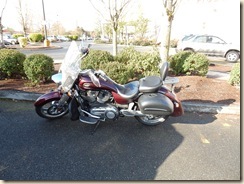
noise on two wheelsAre you getting much sleep these warm summer nights? Nearly three weeks of 90 degree plus weather has us bedding down with the covers flung back and windows gaped open, hoping to coax a wayward Valley breeze into the bedroom. For years I’ve scoffed at the summer season commercials promoting AC. AC, here, in the cool, Pacific Northwest? Paying big bucks to keep three, maybe four days of solar discomfort at bay? Suck it up, I’ve always said. Get tough. Walk it off. What a bunch of whiners. This summer, however, has been a whole different animal, and I’ve found some cooling relief from a small desk fan whirring over me from the nightstand. A little cooling as the perspiration dries…. But I still lack the sleep I need and these sweltering nights aren’t the reason:

Did you know Harley Davidson has a wake-up app? Yes, among the multitude of products bearing the Harley Davidson logo, there’s the “straight pipes, set you bolt upright in bed ” feature. Harley merchandiseFor the second consecutive summer this app has roused me shortly after four a.m. three to four times weekly. Nearly four o’clock on the dot the rumble begins and then down High Rock like a rolling earthquake comes the drone of an unmuffled motorcycle. It rolls to a stop where High Rock meets SR 203 and sits there at a spluttering idle for a minute or so until the rider kills the engine. At 4:04 or thereabouts I hear another rumble approaching from the north. Almost immediately the resting cycle resumes its rumble, pulls onto the State Road and blasts past the house. Fast on its heels comes a second motorcycle, a tad bit more muffled than the first and the two bikes roar off down the road leaving me wide awake and thinking unkind thoughts. The routine has its variations: sometimes both cycles shut down for a moment (a bit early to work perhaps?) and on one occasion I heard the mosquito-like whine of a crotch rocket winding up on the Tualco Road straightaway behind the house. It rendezvoused with the other two and in concert the trio roared off into the dark like a host of stock cars.

In attempt to squelch this decibel deluge, I routinely awake about 3:20, use the triple pane muffle effect, and shut the bedroom windows.  Now, however, sleep’s impossible. I lie there anticipating that inevitable downhill rumble. Will it be just the one irritating bike? Two? Or the full complement of three this morning? Regardless, I know I must at least suffer the loudest of the three as it blasts by the house. Then I must exit my angry place before I finally drift off to sleep.

I’ve seen the movie Easy Rider, saw Peter Fonda slip off his wrist watch and fling it to the four winds. (No time constraints for Captain America.) Ah, the freedom of the open road, all that hair (Dennis Hopper on his chopper) dallying with the slipstream. Adventure over the next rise, around the bend; nowhere you need to be and all the time in the world to get wherever that is…. But can’t you, I plead, be a free spirit without making so much doggone racket? Must all that freedom come at a cost to others? Are mufflers a factory option on those gleaming machines? I suspect not…so just what is it that makes a biker so muffler averse? The wind’s the same; the freedom’s the same; the power, the speed, the thrill, all the same? So why not purrrr your way on down the road? I know some of you bikers must be annoyed by all that noise, too, or why would you try to drown out engine noise by playing your on board radios at top volume?

I’ve seen a car around town sporting the sticker “Loud pipes save lives.” As far as The Ripple is concerned, the only truth to that declaration is, yes, the cacophony of those passing machines without a doubt does attract attention. loud pipes...I happened upon an online article listing the several ways bikers can protect themselves in and around traffic. As a safety precaution, nary of mention of loud pipes, so why “deep six” your mufflers? No, that unfettered noise, in my opinion, is an obnoxious declaration of male ego: “I make a racket; therefore I am.” bikerAural kudzu, auditory graffiti…no other way to put it. I’ve shared my feelings with a friend of mine, a confirmed biker whose chosen ride is a BMW cycle. “Unless you saw me drive by, you wouldn’t even know I was in the vicinity,” he laughed, a tacit statement about the raucous machines the other camp prefers.
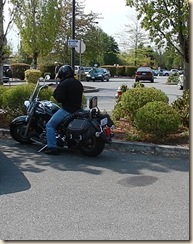
A bit of irony on this topic: did you know the Monroe Public Library has reserved four parking spaces for motorcycles? These spaces offer the closest parking—like handicapped spaces—to the library’s entrance. The irony? That an institution which prides itself on “shushing” noisy patrons would allow these boisterous machines to park within a stone’s throw of what once was considered the bastion of silence. Strange, too--I’ve never noticed a single two-wheeled vehicle of any sort parked in one of these slots. I’ve been meaning to ask one of the library’s staff about the motorcycle parking.muffled bikes only Perhaps a local chapter of that famous motorcycle club has its own book club? Or has there been a resurgence of interest in Robert Pirsig’s existential Zen and the Art of Motorcycle Maintenance? (The “existential motorcyclist”…isn’t that an oxymoron?)

Rain has moved back into the Valley this week, a much wished for reprieve from the summer’s drought. Not only is Mother Nature’s liquor a boon for our parched lawn and garden, but for this noise-induced insomniac it means return to blissful sleep. Rain has brought quiet to the Valley. This long, hot summer the highway out in front, weekends in particular, might just as well have been the highway to and from Sturgis, South Dakota, during rally week. Rain. With it comes the soothing, gentle swish of car tires passing on wet roadways. Blessed rain—the motorcyclists’ anathema. Heaven-sent rain. Mother Nature’s way of saying : “ Hey, you in the leather pants and jacket, cool those straight pipes, give them a rest. It’s time for a little peace on earth.”pipes at rest
Thursday, August 20, 2015

Bottom’s Up or the Parching of the Valley…

Riley's BottomAll day I’ve faced the barren waste

Without a taste of water…

Cool, clear water.

Old Cowboy Western tune

Going into Fred Meyer’s the other day, I passed a man exiting the store, his cart heaped to the brim with cases of bottled water. Just inside the door two or three customers were lined up at the fresh water kiosk. I’ve since read that east of here one of the two wells that supplies water to the little town of Startup has gone dry. I cross the Skykomish River almost daily and these days it appears more bed than river. Where there used to be swimmers, there are now waders. Everett, Seattle, and Tacoma have issued voluntary water conservation measures, urging their customers to cut back on daily water usage ten percent. All this because our endless summer has been a rainless one, and with last winter’s snowpack less than ten percent of normal, our rivers will only dwindle, become creeks, trickles even.

I can only remember one similar summer in the forty years we’ve lived here, but I also recall more rain that season during the “dry months” and though the preceding winter’s snowpack was subnormal, it was not ninety percent below normal. Usually water issues here in the Valley stem from an excess of the stuff not a dearth of it, especially the late fall months when some years past during the night I’d rise hourly and cross the road, flashlight in hand, to see what Riley Slough was “up to.”

And crossing the lower Loop Road over the bridge just two days ago where I normally see a great blue heron, knobby knee deep, or a pair of ducks, (and last summer a busy beaver),… where usually the marsh grasses ebb and flow in the gentle current like a sea hag’s hair, and minnows dimple the surface, I glanced down and was shocked to see a strange sight: Riley’s bottom. Yes, a small gravel bar, surrounded by pools and puddles, is all that currently (or should that be “current less?”) remains of Riley Slough at the crossover. No fish crossing or spawning there this fall; scarcely enough water to wet a minnow.

When the waters are parted, or in Riley’s case, dried up, oftentimes long lost civilizations emerge. Lake Mead’s drought subsidence has yielded up three submerged ghost towns, allowing the ghostly residents to wring the water from their sheets for the first time in years. When our state’s Wanapum Dam on the Columbia was found to have a crack in its spillway, repairs required the reservoir to be drawn down twenty-six feet, a subsidence that left structures submerged for fifty-two years high and dry. (That old swing set the glider component of which nearly crushed my fingers must still be rusting away forty feet below the surface of reservoir behind Douglas County’s Wells Dam Hydroelectric Project.) Hoping to see some long submerged artifact, I peered over the railing at Riley’s bottom but instead of an ancient native firepit or moccasined footprint, I saw nothing but rocks and gravel.

Just last weekend I watched a segment about water on CBS’s “Sunday Morning.” The piece highlighted a Navajo Indian Reservation in New Mexico. None of the “rez” residents have running water in their homes. Within the reservation’s borders there is only one well with potable water. Navajo with vehicles drive upwards of fifty miles one way to fill five gallon buckets with water then drive the fifty miles back with their water ration.  Navajo who don’t own vehicles obtain their water from the Reservation’s sole water truck which because of the territory and families it serves delivers water once a month. That delivery of two to three fifty gallon barrels per stop must last a family until the next delivery. I saw a family of four—grandmother, mother, and two grandchildren—wash their hair in a plastic tub, each using the same water so as not to waste a drop. The reservation is not without other wells, but the Navajo who drank from them became ill from contaminated water, residue from uranium mining of the 40’s and 50’s. Hydrologists believe aquifers 600 feet underground are also rife with pollutants. Deeper wells are needed but there’s the cost (always the cost): the state and county believe it’s the Fed’s responsibility to foot the bill for deep wells; the Fed passes the buck back to the state…states’ rights, you know… the state's responsibility. I think of our great republic where the average American uses 100 gallons of water a day while on American soil descendants of our indigenous peoples—and the WWII Code talkers-- as if they were a 3rd World Country people, must share the same water to wash their hair.

                                                                                                                                                        …Where the water’s running free,

                                                                                                                                                       and it’s waiting there for you and me,

                                                                                                                                                      cool, clear water… (same old western tune)


As Gladys and I wobbled home, I saw the Valley under serious irrigation: the dairies’ big manure sprinklers spraying clear water on the hayfields, Willie Green’s acres of leaf crops drinking up the water from irrigation pipelines, sprinklers going in chard and kale fields (saving our food, my brother says), and Van Hulles’ pastures. I think about a conversation I had with Shay Hollander who floated the Sky from the first launch site on Ben Howard Road. Shay said it took his party nearly three hours to float to Monroe, twice the normal amount of time. I think about our shallow water table and drilled well which has delivered like “Old Faithful”for forty years—only twenty-seven feet deep. (Our old dairy farmer neighbor Herman Zylstra witched our well and when Rob Aurdal drilled it, Herman urged him to drill another four to five feet deeper. “Don’t need to,” Rob replied. “They’ll have all the water they need right here.” And with that, Rob packed up his drilling rig and drove off into the sunset. Old timers have told us we’ll not lack for water as long as there’s water in the Sky. But now waders are crossing the river at will and river bars used to rushing current bask exposed in the ninety degree heat. I’m not saying I want to be on flood watch hour on the hour. But I would like to wash my hair more than once a month. There’s not much of it left. Just a few drops of water is all I'd need… a few drops of cool, clear water.                                                                                                  

                                                                                                                                                     He’ll hear our prayer

                                                                                                                                                    And show us where there’s water,

                                                                                                                                                    Cool clear water

                                                                                                                                                                                  ( there’s that old tune again…)

Friday, August 7, 2015

…in the Cool of the Morning…

strings of pearlsAt six a.m. the world hasn’t had time to make trouble.

Sparrow, “Small Happiness,” The Sun magazine (July 2015)

Too many ninety degree plus days this summer and all this heat has certainly gone to my head. Case in point: I recall a dialogue between two acquaintances on the light-hearted subject of death. Party number one mused  sorrowfully that he’d miss certain things when he was dead. Party number two exclaimed: “What are you talking about? You won’t miss anything! You’ll be dead!” An abrupt end to that conversation.

Right about that, I thought, and at that point decided to take charge of their aborted exchange, redirect the tack of the subject, and set my compass to a more positive heading: “What are the those small things during the day I enjoy?”  In other words, “live in the moment.” I set myself the task of coming up with something that gave me a small happiness during the day. Day One: being able to awake, rise, and greet the new day. Day Two: Ahhhh, that first sip of morning coffee. Day three: sitting out in the evening, watching the commercial jetliners pass overhead en route to Sea-Tac, thinking about the passengers, the places they’ve been, their happy reunions at the airport with loved ones. (This small thing is a big deal to one who nearly lost the sight in his right eye twelve years ago). Day Four: continuing the vision thread, the garden these days is bursting with color, dahlias, zinnias, nasturtiums, morning glory; I see the colors through the eyes of an impressionist painter.morning glories

I’m up early, in the cool of the morning and cup of coffee in hand, have fed and watered the livestock (four chickens) and am now sauntering through the rows of garden produce. The day will be another scorcher, in the high 90’s, they’ve predicted. We’ve not had any measurable precipitation since June 1. At day’s end the cucumbers and squash vines are steamrollered by the weight of the sun. Ten minutes in the garden brings the handkerchief to the brow; the shirt clings to the skin, prelude to an afternoon shower. zinnia patch

But now I’m enjoying the gift of dew the night has left the Valley, and before Ol’ Sol wreaks its vengeance on the day, I wander the rows of beans and corn, sloshing coffee as I go. Dew: yes, the Valley does do dew; hardly a summer morning without droplets pendant from tips of leaves. Pearly teardrops pooled in the crowns of new corn remind me of my old friend Lester Broughton who was Valley-wise even though he lived in town. The first year we owned this slim acre, before our house was built, before the well was drilled, we planted our first garden, and I shared with Les the concern that we lacked means of irrigation. “Don’t need to worry about water,” he replied. “You get dew every night. That’s all the water the corn needs.” And he was right. Dew… I think about the naturalist Charles Darwin who observed that in the arid plains of Patagonia lizards and mice survive in substantial numbers without rain, subsisting on droplets of dew that collect during the night.

A month and a half without rain here in the Valley. Nearly a dozen days of ninety degree plus temps. But this morning the thirsty garden drinks. I have my coffee; the garden sips its dew.