Search This Blog

Saturday, September 24, 2016

First Fall Casualty...


Today I conducted a routine inspection of two colonies in my bee yard and the news was not good.
Less than twelve hours into the autumnal equinox and already one colony is certain to be a mite casualty. Just two short weeks ago an inspection of the hive presented a healthy population of bees and was queen-rite with two or three deep frames full of eggs and newly hatched larvae.
That was two weeks ago, but today the story was much different. I had been monitoring the hive (photo: Hive B) carefully for the last month and knew there was an issue with Varroa mites, several of which I observed clinging to adult bees, sign of a serious infestation. When I removed the lid, I should have seen a healthy, flourishing population (photo: Hive A). Instead of a mass of bees covering the frames, only a smattering remained. For nearly sixty decades bees have been a part of my life and with this mite thing, I'm at my wit's end.


In the late 1980s mites came into our Valley and changed the entire dynamics of beekeeping. Consensus has it that Varroa is now a permanent part of the beekeeping landscape, a fact of life in one's backyard apiary...certainly the case with mine. Just last week I stopped by the Beez Neez Apiary Supply to purchase containers for this year's honey crop.While waiting for Ben to fill my order, two men, father and son, came in carrying two Langstroth deep frames for inspection. The frames, one from each of two hives, had spotty pockets of capped brood, all dead. Both frames had normal honey arches with capped honey. One look at the frames and I knew mites were to blame. "There were no bees in either hive," they said. "Don't know where they went...they just disappeared." Their plight was now mine: my hive, to all appearances thriving two weeks ago, was now destined to extinction.


The frustration for us beekeepers is this late summer dwindling (as if "spring" dwindling wasn't challenge enough). Hives that survive the winter, experience the normal spring build up, and are booming during the summer months, seem to hit the wall in early to mid-August. This stands to reason when you think about it: as colony population builds, so do the Varroa...more brood for them to feast upon, which the voracious critters do until at last they overpower the hive.

(Note photo below: newly emerged adult bee with wings chewed by mites, attacked while in its incubation stage.)


This observation has led me to be diligent with mite management; you know the little varmints are and will be ever present in the beeyard and the latest literature and research suggest the beekeeper use IPM (Integrated Pest Management) to keep mites at a manageable level to ensure a colony successfully overwinters. This balance of mite vs. colony population swings in the way of the mites in mid-August, so I began treatment with the organic miticide Hop Guard (HG) the second week of August. The hive at issue not only had two treatments of HG in August but also the drone comb frame application (although with less dedication, I have to admit). When I noted the clinging mites and the drone larvae infestation, I treated the colony with a formic acid pad. All to no avail. The mites have prevailed and the colony is doomed:  I'm at a loss at what to do at this point, which will prove to be too late anyway. What is staggering to me is just how fast mites can dispatch a colony. It's like the "Zero to 60" vehicle ads. Two and a half weeks ago the second brood chamber was full of bees and at least two full frames of eggs and larvae. When I removed the lid today only a few bees were clinging to the frames and just small portion of one comb had eggs and larvae present. My guess is the decline in nurse and attendant bees caused the brood to die. "Aggravatin,' ain't it?"

Hive #2  seems in peril, also. As to the cause, I'm not certain. This colony went queenless over a month ago. An inspection showed a number of queen cells, enough to be swarm cells, although in early August swarm possibility seemed a non issue. Two of the queen cells were capless and I spotted a virgin queen milling about on one of the combs. Today I fully expected to see a nice brood pattern with brood in all stages of development. No such luck. I inspected a number of combs in both brood chambers. All I saw were the smooth, shiny bases of the cells; no sign of brood rearing whatsoever. The population seems to be holding steady, sign that mite population for the present must be at a manageable level. I decided to give the hive one last chance to raise a queen, removed a frame of eggs and larvae from another hive, and inserted it in the center of the second brood box. If the hive does raise a queen, fall weather will most likely prevent her from taking her mating flight. My prognosis is this hive will go the way of  hive #1.

The latest weapon I've added to my IPM's arsenal is oxalic acid (OA) which is applied by means of a flashpan tool inserted into the hive. A twelve volt battery powers the flash pan and in three minutes the measured dosage of OA powder vaporizes, filling the brood chambers with the fumes. The fumes coat the bees and mites with a patina of OA crystals which the bees tolerate but is lethal to the mites. OA fumigation purports to be the cutting edge of Varroa control. We'll see. However, each new trend in mite management could prove to be the panacea and sustains my hope. These days it's essential a beekeeper be an optimist.

But in the meantime the aggravation continues....

Sunday, September 18, 2016

O Pioneer! Dorothy Rae Lewis, March 13, 1916-July 16, 2016


"It takes life to love life."
"Lucinda Matlock," E.A. Masters' Spoon River Anthology

What a run you had, Ol' Gal, a centenarian you were and you wrung life til it hurt every day of those one hundred years. March 13, 1916, you came into the world. What must that desolate Dyer Hill day have been on the cusp of winter and spring? I imagine snow drifted wheat fields and sagelands and a Dyer westerly, cold enough to freeze cattle, rattling the eaves of that rough hewn homestead that heard your first cries. You had your dad Bert Baumgardner's spirit, Ol' Gal, your father, exasperated when basalt cobbles repeatedly tripped his plow, halted his team, shook his fist at the heavens and dared the Creator to come down and fight him like a man.
You were one of five girls: "Bummie's Boys neighbors called you and I'll bet there wasn't a country boy miles around that could keep up with you or your sisters. You scraped together pocket change by trapping skunks, skinning them out and sending the hides to Sears and Roebuck. You told me an occasional cat skin somehow found its way into some shipments. ("There wasn't a cat in the neighborhood," you told me. "Dad would have skinned us alive if he found out.")

You learned your three R's at the White Swan School and received perfect attendance/never tardy certificates in spite of doing morning chores before you walked to school. ("On bitter weather days, Dad would pick us up in the sleigh after school and we'd bundle ourselves in warm blankets for the ride home." An eighth grade education was all you had, Ol' Gal. The nearest high school was fifteen miles away in Mansfield and further education was out of the question. According to your eighth grade diploma you scored highest in "arithmetic," lowest in "spelling." (How many times in your letters, Ol' Gal did you apologize for your spelling? Which of the teachers who signed your attendance certificates slapped your wrist with a ruler because you misspelled "come?")

For the first time since that March day a century ago, Ol' Gal, you are now truly at rest. There is so much I want to say to you, old friend, as you lie there, but writing is difficult because words to describe you and your life just don't seem equal to the task. I've always told myself if I were to write about the inspirational men in my life, you, Ol' Gal, would be among them. Gently I press your hands, folded one upon the other and think about the lifetime of work they've done, your left hand missing the little and fourth finger, severed by a friend's power saw ( you were doing a good deed for a friend because she didn't know how. You had the doctor remove the fourth finger stub because, you told him, you didn't want it catching on things as you went about your work...the severed finger retrieved from piles of sawdust and saved in a jar at your request now lies with you for eternity.)

You were a part of my life for six decades, Ol' Gal, yet as down to earth as you were, in some ways you were a mystery. Things I know for sure: you delighted in work (and work it was that really defined you; on your 100th birthday, four months before you passed, I gave you a box of walnuts.
It took you three days but you shelled them all); you were a good neighbor, helping those in need, whether it meant delivering a child, a meal, mowing a neighbor's yard, or taking the time to put your work aside, sit down and chat; making things grow: your apple trees or vegetable garden (the best in the county, the success of which you attributed to the Farmer's Almanac, but really Ol' Gal, it was that ton of manure you turned under in the plot every spring... admit it now). By mid-February your windowsills were a grove of tomato plants itching to get in the ground the day after the last frost.

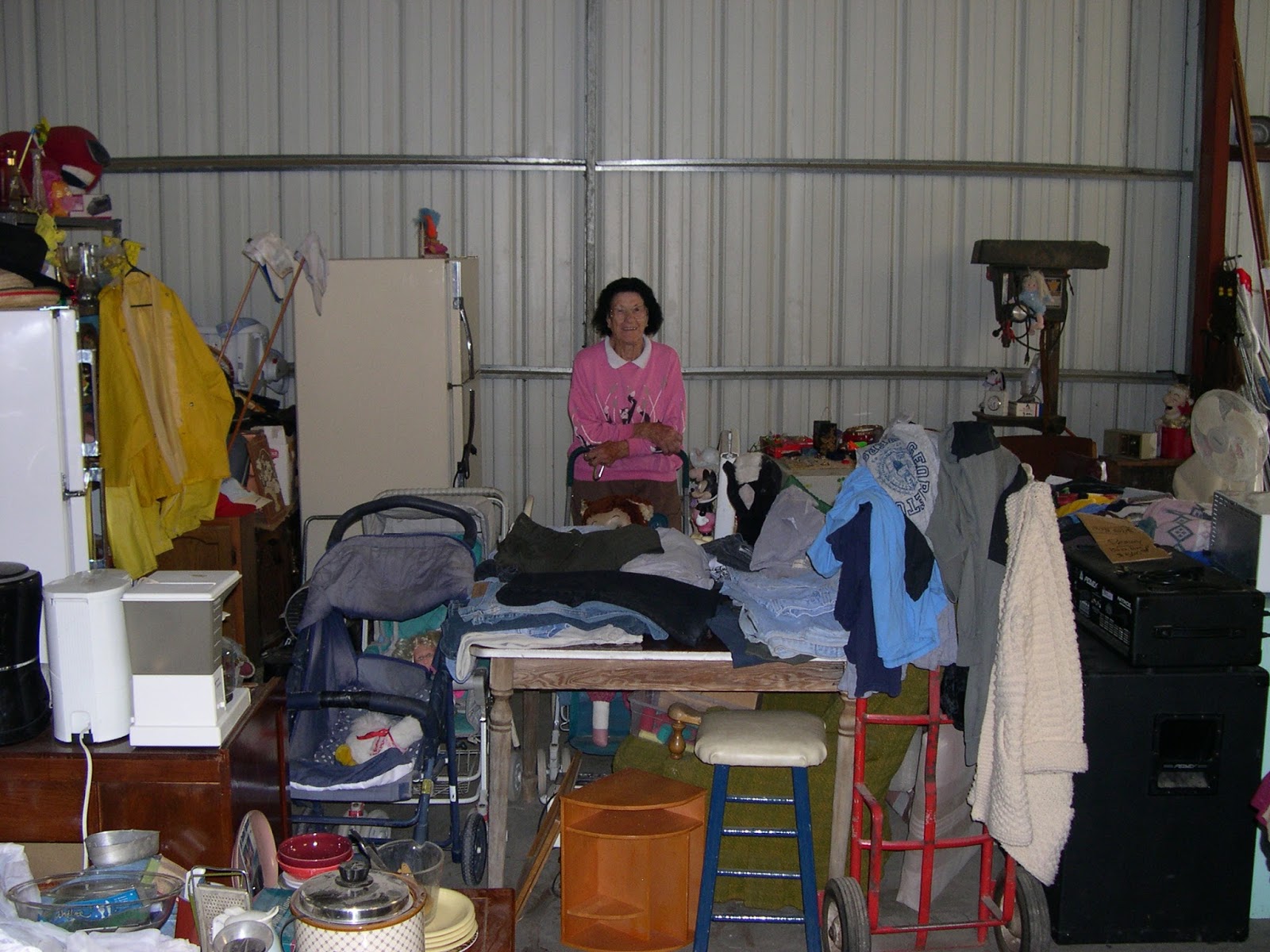
You were a collector of stuff, Ol' Gal, "stuffed" stuff: dolls, animals, commemorative plates, salt and pepper shakers, glass figurines, a full-sized wooden doll from Thailand (through whose wooden neck you drilled a hole for a necklace chain and stuck her in a corner where she could stare out at your company through your dad's old wire rimmed glasses.

You were a curator of oddities: a mummified squirrel's foot from a roadkill, a hornet's nest, a life sized cardboard stand up of a scantily clad woman, chainsaw art.... The letters I sent you were addressed to the "Dorothy Lewis Roadside Museum, c/o Dorothy Lewis."
(Our personal joke). Two or three days a week you sold items from your "thrift shop" across the street. I called your flea market "the perpetual garage sale."


And I, a teenager at odds with his parents, you took me in, gave me free room and board while paying me wages for the work I did. ("You write your mom now," you insisted during my two month "vacation" from family. "She loves you, you know."

And the stories, Ol' Gal,..those hardscrabble years on Dyer. How a young nephew was dragged to death behind a horse, a niece who drowned in a freak ferry accident. The time you were at a dance and your partner accidentally bumped a passing couple and was knocked to the floor by her partner. You snatched your partner from the floor and continued dancing as if nothing had happened, he still semi-conscious. When your husband was unable to put down his longtime pet dog, you picked up a rifle and did what he couldn't. (Any stray dog you caught on your property got the rubber band treatment if the trespasser was male.) You were a loyal friend and neighbor, Ol' Gal, but woe be it unto those who got on your bad side. Then it was a view-obstructing poplar "spite fence." Of the son of a bothersome neighbor you said, "I wish I'd a' shot the S-O-B when I was sixteen. I'd just be gettin' out of jail now and he'd be dead.) There are other stories, too, but I won't tell them. I've said too much already, Ol' Gal, And you'd likely not approve, the private person you were.... (Shhhhh, old friend, I swear...no Face Book posting.)

I can never recall seeing you without jet black hair, Ol' Gal. You said one time if you were to look in the mirror and see gray or white, you would shut right down and die.
Now, as you lie there, Ol' Gal, your hair midnight black against the white satin, I think about your pioneer toughness: the time you fell from a ladder harvesting fruit and broke your hip. You crawled to the tractor, trailered a load of apricots to the loading dock, and made your son Ivan stack the boxes in the cold storage unit. THEN you had him drive you to the hospital. You would be up at five a.m. moving waterlines, work all day, stopping briefly to fix lunch and supper for the household, then on a hot summer night you would toil away over a bubbling canner full of peaches. You could do the work of two men. I know. I worked alongside you, struggling to keep up.

Years of letters, postcards (from your world travels), nearly two shoe boxes full. Two or more a month.We always tried to outdo each other on the holiday cards. I would send your Christmas card the day after Thanksgiving. And yours was always the first Christmas card to arrive in our mailbox.You loved sending clippings from newspapers and magazines, articles about bees and butterflies--you knew I liked them--silly pet ads to make me chuckle.You continued to write even though a stroke made writing a frustration for you; letter after letter became a challenge to decipher. Your letters continued, though less frequently, envelopes addressed by your daughter-in-law, Joy. Even though the last few were mostly illegible, I loved receiving them because I knew you were thinking about me. May 25, an early birthday card from you, the last card or letter you'll ever send me. Trips to the mailbox will never be the same.

It was your letters, Ol' Gal, that allowed a glimpse into a spiritual life you held private. In one letter you wrote about a full moon, its beauty, how "They should stop fooling with it. It's God's moon. Leave it alone," you said. I marveled that a woman in her nineties would have those thoughts. You did not want the fuss of a funeral but agreed to a graveside service. When in her teen passion your eldest daughter got religion, you told her to stay in her room for a week and "then see who feeds ya." But you knew what was going on in the world: the Middle East, here at home,the mass shootings, storms, floods, the loss of life, the suffering. One of the most commonsense statements I ever heard you make came after the death of Saddam Hussein. Your comment: "He had 'em all in line, that old man, and they went and killed 'im."

You raised five children and one grandson, O Pioneer.
When your first husband left for parts unknown, your in-laws willed you their orchard because they knew it would flourish under your care. And you did it all, Ol' Gal, every orchard task there was to do and yet found time to drive combine during wheat harvest.You never missed an opportunity to do a good deed, whether it was helping a neighbor laboring in childbirth, sharing the bounty from your amazing vegetable garden, taking a hot fruit pie to a worker's cabin--or sheltering a rebellious young man until he got his head straight.You would never admit it, Ol' Gal, but you made the world a better place. And you gave me so much, good friend: memories, laughs, good meals, companionship, a down to earth perspective on life, living, and the importance of  honest, hard work. And don't forget your construction helmet, my legacy from you, symbol of your work ethic, the many times I saw you laboring away, that aluminum helmet glinting in the sunlight as you pruned, thinned, propped and harvested your apple and vegetable crops.


I have to do it, Ol' Gal, one last little jibe at you. Your wooden horse, remember? The one you requested from the chainsaw artist commissioned to carve the stump outside your house? "A horse," you said, "I'd like a horse."
And a horse you had...for awhile, anyway, until one day you looked out and saw your black stallion sawed down and carted off to the high school where it prances yet today. Forgot, didn't you, the mustang was the school's mascot. Should have asked for a cow, I joked. The look on your face as your horse rolled away would have been priceless. I wish I could have been there to see it. 

I miss you, Ol' Gal. Saying good-bye to you is saying farewell to a part of my life. I hope none of what I've written here offends you, old friend, for how I feel, what I've said, is true. I love you, Ol Gal. And you know how much I hate poplar trees....


Saturday, July 30, 2016

Go Native...


One sunny day when the canes were in full bloom, I wandered out to my black raspberry patch and was gratified to find eight different species of pollinators hard at work among the blossoms. I counted at least two species of bumble bees, two or three honeybees, a pair of solitary native bees, both different species, a wasp, and a California hairstreak butterfly.

Pollinators, their plight and diminishing numbers are much in the news these days, and while the honeybee and Colony Collapse Disorder (CCD) claim much of the spotlight, one should note that 80 per cent of pollinated crops in this country is effected by native bees and other pollinators. According to my hymenopterist friend Don Rolfs there are some 600 species of native bees in Washington State alone and at least 4,000 nationwide. When you think about those numbers, consider the vast potential for pollination the nation's horticulturists and agriculturists have in their (and our) favor. Recognizing the pending agricultural crisis, the Federal Government last year initiated the National Strategy to Promote the Health of Honeybees and Other Pollinators, earmarking 82 million dollars for the program.The Strategy addresses three issues:
  • Cut the number of losses of overwintered honeybee colonies to 15 per cent (Note: many beekeepers lose all or a majority of their hives over winter...in my case five or six hives.)
  • Increase the population of the monarch butterfly to 225 million butterflies occupying approximately 15 acres in the overwintering grounds in Mexico.
  • Pollinator habitat Acreage: restore 7 million acres of land for pollinators over the next five years.
I am of a mind that one can't have too many bees on one's property, especially if he or she gardens or has fruit trees. My honeybees have set the apple crop on our one slim acre to the heaviest in memory. But one doesn't have to tend honeybees to encourage and sustain populations of bees and other pollinators on his property. Perhaps the best examples are tube bees, communal bees (bees that nest in the same vicinity but carry out solitary reproductive cycles) that lay eggs and raise young in tubes.
The orchard mason bee is the most popular and well-known tube bee pollinator. To sustain working adult populations, mason bee cocoons can be harvested in fall, and reintroduced the following spring.

A few years back my brother Kevin gifted me with a creative and practical gift any bee lover would welcome: a nest box packed with six inch bamboo tubes of various diameters fashioned from bamboo canes he cut from his bamboo "forest" at Chipping Twig Farms in Orting.
Mason bees don't do well on our property. Masons only have a range of a hundred yards and nest close to food sources. Bee forage, I suspect, is slim here in early spring when the masons begin their cycle. (The urban bee lover should be gratified to know masons flourish in city neighborhoods because of the diversity of pollen and nectar sources in the urban landscape.) In July, however, native bees throng to the bamboo tube box. At midday half a dozen or more busy insects flit about the box, working the tubes.


Miner bees also flourish on our property. I first noticed little mounds of soil in the garden and alongside the driveway. At first glance I thought them to be worm castings, the byproduct of night crawlers. Closer observation proved the hillocks to be access tunnels dug by miner bees, mining subterranean homes for themselves. One species of miners is a dazzling iridescent green, a striking little beauty less than half an inch long.


Even if you are a rural resident with a mere postage stamp lawn, you can do much to encourage and sustain a pollinator population in your backyard. For one, make your property a bee-friendly habitat: choose and apply organic pest and weed controls where and whenever possible.

And don't forget the bumblebee, that hearty foul weather flier you will find buzzing about the spring blackberry and blueberry blossoms. They will brave light rain and drizzle when honeybees and small natives stay indoors warm and dry. This spring bumbles established a colony in one of our bird nesting boxes. (The Man Who Poked the Bumblebee Nest, 5/4/2016)

Houses for tube bees take up little room. Hang them on your fence, above an exterior entryway, from a backyard tree. Bee houses, tubes included, are readily available at garden shops (nice for gifts, too, especially if you have your own bamboo grove).

A container garden--vegetable and floral--creates a symbiosis between the gardener and his apis-type friends. Alliums, zinnias, certain varieties of dahlia are pollen and nectar rich (alliums are bee magnets). The Butterfly bush or buddleia is a pollinator's delicatessen. Vegetables: cucumbers, zucchini, squash and pumpkins are pollen producers and proliferaters.
As the squash blossoms unfold in the morning sun, honeybees furred and laden with pollen particles valiantly seek the necessary lift for the flight back to the hive. Native bees, I've discovered, are partial to tomatillos and on a late summer day nearly every blossom  in the garden has a striped native bee foraging on it. In today's pollinator-conscious world a brief search is certain to turn up lists of plantings bee lovers might select to create pollinator and butterfly gardens in their backyard and property.

So make your backyard bee-friendly. It's a good way to study bee behavior, a great opportunity to teach the younger generation about bees, allow them to observe nature's "busy bees" up close and personal, help children understand bees are the gardener's friends, not something just to swat at. And bee watching allows the gardener to take a welcome break once in awhile from those seemingly endless gardening chores.

Saturday, July 16, 2016

At Sixes and Sevens...


An interesting phrase, this one. I first ran across the saying in the script of Thornton Wilder's play The Skin of Our Teeth. I was a high school drama director at the time, and as it was my directing debut, I had something to prove. First time directors, I'd heard, often chose Wilder's Our Town because the staging required a simple set, a bare stage with chairs representing cemetery plots. The Skin of Our Teeth, on the other hand, called for elaborate sets and numerous set changes which the set crew rehearsed countless times so that each took less than three minutes.

The context of the phrase: the Antrobus household is in a topsy turvey state because father George has failed to return from work at his customary six o'clock time. Lily Sabrina, the household maid, sums up the turmoil by saying: "It's the coldest day of the year. The dogs are sticking to the sidewalks. The world is at sixes and sevens." In other words, things are in a state of chaos, disorder, disarray.

I've been thinking about that phrase a lot these days. Geopolitical turmoil, terrorism rampant ("The Middle-East is everywhere," someone recently said), mass shootings here at home. I can't remember the last time I've seen the flag flying high at its masthead. The current political scene: someone who's never had a job suddenly wants one; the other, who has had several, given a tainted resume, will have a hard time finding an employer. The oceans are warming, melting the heat reflecting icecaps. Our refrigerator ice maker is on the fritz....

And I'm expecting a phone call at any moment. The news will not be good.

The world is at sixes and sevens.

Monday, July 4, 2016

A Foolish Consistency: a Literary Digression...


Strange where one's head goes when pricked by certain stimuli. Take this morning, for instance, when Gladys and I rolled out into the mist for our constitutional in the Valley. Propped up at the entrance to Jim Cabe's driveway was a garish orange warning sign. I knew it was the weekend before the anniversary of our Grand Old Republic but thought it highly unlikely Jim would be hosting a celebratory Hell's Angels motorcycle rally: as if the Cabe residence is the Sturgis of Tualco Valley. Besides, if a biker can't navigate 200 yards of roadway without tipping his bike, he shouldn't be straddling one...unless, perhaps, it's a trike.

The County has been prepping the Upper Loop Road for resurfacing all spring. I first noticed the white graffiti highlighting pavement cracks. Then the serpentine black sealer cover up, (one looked suspiciously like a '60's peace symbol; County guys having a little fun?). Yellow plastic tabs next and the gravel overlay for the asphalt to follow. Thus the warnings for bikers rumbling (screaming?) devil-may-care through the Valley.

But propping a warning sign at the head of a long driveway seemed a bit superfluous and brought to mind a string of literary allusions, the first of which was Emerson's famous quote from his essay "Self-Reliance": "A foolish consistency is the hobgoblin of little minds/Adored by little statesmen, philosophers, and divines."Another on the topic of consistency stated by Kenneth Roberts in the forward to his novel Lydia Bailey:

"...; narrow men who consistently upheld the beliefs and acts of one political party and saw no good in any other; shortsighted men who consistently refused to see that the welfare of their own nation was dependent on the welfare of every other nation; ignorant men who consistently thought that the policies of their government should be supported and followed, whether these policies were right or wrong...;"

And then there's the poem "Mending Wall" by New England's poet laureate Robert Frost in which his subject is a stubborn neighbor whose "foolish consistency" binds him to the old saying "Good fences make good neighbors." As he complies with the neighbor's stubborn demand they annually repair the stone wall dividing their properties, Frost maintains their labors are just "another kind of outdoor game...there where it is we do not need the wall:/ He is all pine and I am apple orchard./ My apple trees will never get across/ And eat the cones under his pine trees, I tell him." But the neighbor "...will not go behind his father's saying,/ And he likes having thought of it so well/ He says again, 'Good fences make good neighbors.'"

Our County servants, in their defense, constipated by regs, codes, and guidelines would be the first to justify--consistently, of course-- the misuse of common sense and resources as "We're just doing our job." After all, Jim Cabe's driveway is a designated "County Road" (Christenson Rd.), thus must be posted with the cautionary warning. However should Gladys and I decide to visit the Cabes, we'll heed the advice and pedal carefully because Gladys is like William Faulkner's mule, "[She] will work for you patiently for ten years for the chance to kick you once."

Just one more allusion for you. No need for thanks. Call it literary lagniappe.

Saturday, June 18, 2016

The Humble Pie: Gooseberry...


I readily admit the worst pie I ever made had a gooseberry filling. Unpalatable it was, to say the least. Just one bite and into the garbage with it...a total waste of my time and one perfectly good man crust. But you capitalize on past mistakes, right? Thus my next gooseberry pie, if not the best pastry I ever made, was certainly the most exotic, a gustatory treat down to the very last mouthful. Here's how the tale of the two pies unfolded.

When you have an horticultural bent and one slim acre with which to play, you may be inclined to try a little of this, some of that. I like to think of our place as "the Valley Sampler," and in keeping with that moniker I've added gooseberries to the backyard garden.

Just how the cultivar came to be called the "gooseberry" I have yet to discover. In fact, one plus of the gooseberry is, unlike our other berry crops, birds avoid it; the bushes require no protective netting. When I tell them I grow the fruit, most people ask for an explanation; not only have they never seen a gooseberry but mere mention of the plant is usually a first for them.

The gooseberry is native to Europe (Ribes uva-crispa) and put to a variety of uses there, primarily in preserves, jams, jellies, and conserves. I cultivate two bushes: the Old World variety and the North American strain Ribes hirtellium. The former fruits a green berry that ripens to a yellowish color; the latter, a larger fruit, purple when ripe.


I was excited for my first crop, anxious to make a batch of jelly. Although the fruit is uncommon here in the U.S., I had no trouble finding a jelly recipe. In fact I found recipes for jam, preserves, conserves, and something the English call a "gooseberry fool," a dessert concoction of stewed gooseberries in sweet custard. All recipes gave precise proportions of sugar and juice, cooking times, processing and storage guidelines, which was all well and good...but not a one told you WHEN THE GOOSEBERRIES WERE RIPE. I picked the berries at the "pucker" stage of ripeness, the point at which my grandson, whose four-year old palate craves sour things, screwed his face into a Shar Pei's likeness when he crunched down on the green orb.
The jelly turned out so-so...certainly sweet enough (after all, jams and jellies are nothing more than fruit flavored sugar) but had very little flavor.

Then came the pie fiasco. And you know how that turned out. More research needed: how to tell when a gooseberry is ripe. This is what I learned--post pie disaster unfortunately. First, there's the "squeeze" test. Take a berry between the thumb and index finger and squeeze, If the result is like pinching a marble, save the berry for my grandson; however, if the fruit "gives," is sponge-like, it's pie-ready. The pie maker can double check by the "taste" test. The berry should have a sweet-sour quality: the flesh sweet; the skin tart.

After climbing to those heights on the gooseberry learning curve, I attempted pie number two, a recipe I found for "Old-Fashioned Gooseberry Pie," the ingredients of which complement the unique flavor of the fruit. The ingredients follow:

5 cups gooseberries, blossom ends and stems removed
1 1/2 cups sugar
2 Tbsp grated fresh ginger
Juice and zest of one orange
1/3 cup instant tapioca
4 Tbsp butter (set aside for later)

Combine all ingredients except butter in a large sauce pan and place over medium heat. Cover until gooseberries start to soften and burst (about 5 minutes). Then uncover and keep barely simmering on medium-low heat for about ten minutes. Remove from heat and cool.

The crust: one Man Crust (top and bottom). Form bottom crust in a nine inch pie plate, fluting the rim of crust. Weight with pie weights and bake at 375 degrees for ten minutes or until golden brown. Ladle in filling, spread butter in dollops evenly throughout the filling.

Top crust: using the rim of a small glass or cookie cutter, fashion circles from the pastry and layer them in a concentric circle pattern, leaving a hole in the middle and an inch to an inch and a half space between rim and outer ring of pastry. Whisk together one egg and a Tbsp of milk and brush the pastry circles with the egg wash.

Bake at 375 degrees for 35-50 minutes until vigorously bubbling. (Suggestion: set pie on a metal sheet or pizza pan; filling will bubble over.)

Approximate time to prepare: 2 1/2 to 3 hours. Note: Much longer if you have to pick the gooseberries. Longer yet if you have to grow them. Good luck.

Attribution: beekman1802.com/recipes/old-fashioned-gooseberry-pie


Monday, June 13, 2016

A Bother of Wasps...


KATHERINE: If I be waspish, best beware my sting.


PETRUCHIO: My remedy then is to pull it out.

KATHERINE: Ay, if the fool could find where it lies.

PETRUCHIO: Who knows not where a wasp does wear his sting.
                        In his tail.

        Shakespeare's The Taming of the Shrew

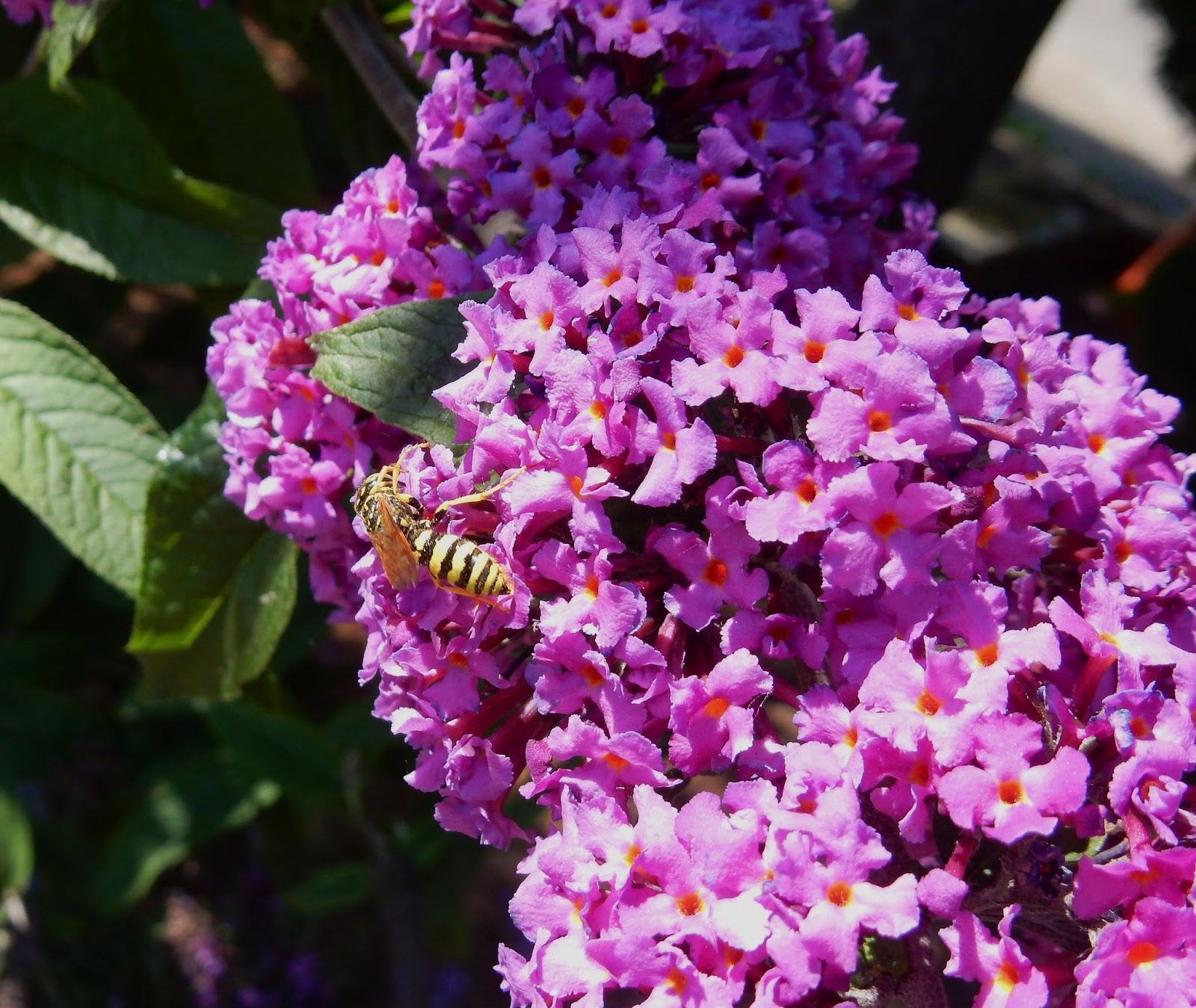
The collective noun for wasps is "pladge" as in a "pladge" of wasps. That may be but considering the waspish invasion that's descended upon our property, I much prefer the collective a "bother"of wasps. On any given warm spring day they are everywhere, drifting along on the breeze, legs dangling like tails of a kite. A fog of them cascades from the shake roof. I find their nests in the strangest places: an empty flower pot, inside my little greenhouse cloche, under a piece of scrap lumber. Just the other day I removed three small nests from inside the chicken coop. Nests hang from the soffits, the carport, the eaves of the shed.
The woodshed is a favorite nesting place for them. Before I remove a stick of firewood from the stack, I inspect the underside of the roof for their telltale gray cones. Many's the time I've gingerly removed a stick from beneath a nest bristling with the bothersome things, each posturing for assault. Their numbers seem to grow each year, their nests more plentiful, the airspace filled with more and more. Our swallow nest box has remained vacant for two or three years because, I'm fairly certain, they tired of the wasps' incessant pestering to gain access. For years a pair of violet-green swallows nested in our roof gable, but the hordes of wasps living under the cedar shakes proved too much competition for them. If the day's a warm one and I leave the truck windows down for ventilation, I'm certain to have a couple of wasps riding shotgun with me when I run my next errand.

In the two story ranch house, my home as a boy, every fall wasps would build nests in the attic above the knotty pine plank that covered the ceiling pitch of my bedroom. In the warm autumn afternoons they would ooze from the hot attic and cluster around the light fixture in clumps of forty or fifty. I learned from experience that at anytime one was likely to drop on me or an unsuspecting visitor and sting upon impact. At bedtime you'd be well advised to inspect the bed clothes before you slipped under them.

It became my ritual those Indian Summer afternoons of clumping wasps to sanitize my sleeping space. Home from school I'd rush upstairs to assess the day's battleground and find a clump or two clinging from the ceiling. Next out came the folding card table which I'd set up to one side beneath the enemy. Laying a fly swatter close by, I'd prepare the necessary ordnance for the assault: projectiles fashioned from newspaper, each with a fold in the middle so I could get a firm purchase with thumb and forefinger. I knew an all out attack would be a mistake: swatting a clump of fifty or sixty wasps was likely to cause painful retribution. (Unlike honeybees that are armed only with a single shot because of their barbed sting, a wasp is--or can be, should it wish--a repeat offender and do a stinging dance up and down a bare arm. Snicker snak....) Strategy was to even the odds: take out a number of the enemy, trim their numbers, until one or two swats could dispatch the remainder.

I began the offensive by slipping a stout rubber band over my fore and middle fingers, hooking a paper missile between the strands, and taking careful aim at the nest, let fly, and dash under the card table when a direct hit would tumble six or eight to the floor where they lay momentarily stunned. I'd rush out and whale away with the swatter, make short work of them. The battle would continue until only a half dozen remained. First making sure my shirtsleeves were rolled to the wrist, the rest I'd take on mano e mano. The wasp wars lasted until the October frosts dispatched my ceiling foes.

These pesky fellows are paper or "umbrella" wasps, genus polistes, a commonplace North American wasp: "umbrella" because of their nests of open faced hexagonal cells (unlike the archetypal football-shaped nest of their hornet cousins), housing for developing larvae. Wasps attach the nests with a thread-like pillar or "petiole" around the base of which they secrete an ant repellent.

If you're a reader of The Ripple, you know I'm hypersensitive concerning the subject of bees and quickly come to their defense whenever someone confuses any bug that flies in his face or buzzes in his ear as a "bee." Most likely the culprit is a wasp or hornet--and of those two, I'm putting my money on the latter. Not only do wasps and hornets differ in appearance, so do their flight patterns.
Wasps are drifters in flight. Long legs trailing behind, they laze through the air seemingly without purpose. Hornets bullet along as if they were high on amphetamines, darting here and there like insect hummingbirds. If an obnoxious, supercharged bug tries to appropriate your piece of barbecued chicken at the picnic table,
you can bet the party crasher is not a bee but a hungry hornet.

Although bothersome, I admit, wasps serve the gardener by pollinating his crops, berries in particular. These little paper sculptors are seldom aggressive and if you're uncomfortable with their presence, instead of dosing their nests with a noxious chemical, encourage them elsewhere by removing their nests with a swift swish of a broom. A word to the wise: just don't surprise a nest of them as Kelly Bolles did the other day. I stopped to chat with Kelly and he showed me his swollen right hand, puffed up by protective wasps when he accidentally laid hands on their hidden nest while cleaning his gutters.