Search This Blog

Thursday, May 28, 2020

Tree Hugging...


There was a match found for me at last. I fell in love with a scrub oak. 
                                       Henry David Thoreau


I willingly confess to so great a partiality for trees as tempts me to respect a man in exact proportion to his respect for them.
                        James Russell Lowell

The best time to plant a tree: twenty years ago. Or today....

Countless times over the years I have driven past this stately giant. I like to call it my favorite tree. Regardless if you're headed either east or west, the tree is hard to miss. It towers above the vine maple and other roadside shrubbery, majestic, mast-like, a tree my two brothers, loggers in another life would have called "a big stick." Most likely the tree was impressive at the time of my birth and barring some cataclysmic wildfire or, heaven forbid, timber sale, it will be standing long after I have passed on.

Pinus ponderosa, my pine tree. One could not find a more perfect specimen among forests of its kind; you might say it is a Pinus in the classic style. The tree stands on the north side of Highway 2 between east bound mileposts 87-88 some fifty feet off the shoulder. At milepost 87 the highway curves beneath a railroad overpass, my cue to look for the tree's familiar spire. Beyond the curve the highway straightens and I see my tree, its trunk plumb bob straight, signature bark furrowed and creviced. "Ah, there you are, old friend," I think and if I'm not driving, I take in the welcome view as we pass, crane my neck for one last look to watch the pine fade from view.


The noble Ponderosa is the tree of the West, the American frontier, so archetypally western that a fictional ranch in a T.V. series bears its name. Old growth Ponderosas are immune to wildfires as their branches grow far above the understory ladder vegetation that fuels fires. The tree's thick bark renders it nearly fireproof, subject to a superficial scorching only as the fire burns about its feet. Native Americans use its tri-cluster needles in basket making. When a breeze sifts through a pine grove, the needles become musical instruments, fragrant aeolian harps, that sigh the ancient song of the Ponderosa.


To my favorite pine: let me share some recollections and memories. In my Boy Scout days I used your sap as a fire starter. Thanks. The fragrance of sunbaked pine duff on a hot summer day brings to mind childhood and the school bus trips to July swimming lessons, windows down, pine scented air wafting through the bus, cooling our hot faces. Apples in my boyhood days were freighted from the field in pine boxes, boxes I tediously repaired for two cents apiece during summers. The box sides came from the mill in bundles, twenty or so strapped with a wire band. I'd pop the band with my box hatchet, releasing the fragrant odor of fresh milled pine, the sawdust still damp between the boards. You gave us winter firewood, too, slabwood sawed to square the logs and cut in fireplace lengths, hauled by Mumma's Trucking and dumped in a pile next to the yard. We burned it green, fresh from the summer's harvest at Martha's Mill. Winters I pried many a frozen slab out of the snow covered pile and laid it by the hearth to warm.


One late spring when the river was in flood a monstrous ponderosa saw log escaped upriver and drifted by our riverbank. I secured it with a rope and after the waters receded, the log took up residence on the bank, lay there for two or three years. Periodically when I had frustrations to vent or felt the need for exercise, I'd take my maternal grandfather's hefty single bit ax, his legacy to me, and lay into that big log, make the chips fly. Each year I'd deepen the notch a couple of inches, perhaps nearly a foot of log chopped away. One spring when the river was on the rise, I untethered the log and let the rising waters carry it downriver, out of my life, our time together represented by that shallow, random notch.

And my old dairyman woodworker neighbor was laid to rest in a pine casket, handcrafted by its occupant during healthier times, preparing for the end game he knew must inevitably come.

H.D. Thoreau during his experiment in simplicity and bean farming at Walden Pond reported in winter he "...tramped eight or ten miles through the deepest snow to keep an appointment with a beech tree, or yellow birch, or an old acquaintance among the pines...." Yet year after year I've passed that majestic conifer, never once stopping to introduce myself, make the tree's acquaintance up close and personal.

We pull over on the shoulder where a wide spot awaits as if it were a convenience stop for tourists visiting an historic site, which for me, I guess it is. I cross the road, camera in hand, for our first meeting, an historic event for us both.

I make my way down the shoulder and thrash about through the tangle of vine maple and brush until I'm within arm's reach of my tree's iconic trunk. While the pine doesn't seem to mind the commotion, a snowshoe hare, mottled, in transition from winter's garb to summer's, though definitely curious at my presence, decides that discretion is the better part of valor and darts down a bunny trail, leaving just the tree and me to ourselves.


In addition to the camera I have brought along a tape measure to record the tree's circumference, the extent of my foray into dendrology. When I was a boy, my fifth grade class visited a logging camp where a forester demonstrated how to determine the age of a tree by using an increment borer. The tool enables the dendrologist to remove a core from the tree. The rings in the core reveal the tree's age. An increment borer is not among the few tools I own and besides, on this, our first date, how rude to poke a hole in the tree's belly. About chest level I tack a small nail into the thick bark, hook the end loop of the tape measure over it, and slowly unspool the tape as I walk around the bole. Back to the nail where I mark the measurement on the tape: circumference 133.5." Approximately eleven feet around, my pine. How tall the tree is I have no idea. When I gaze up the trunk, the top is hidden by the high branches, hard to estimate its height. Of a tree's length Abraham Lincoln said, "A tree is best measured when it's down." It is my sincere hope this old growth giant is never measured in my lifetime.

If Thoreau could fall in love with an oak tree, I reasoned, why couldn't I be smitten likewise with a Ponderosa pine? Not sure my affection for the old pine is true love, but I'm not ashamed to admit I did throw social distancing to the winds and gave the old pine a hearty hug.

Saturday, April 25, 2020

Forensic Beekeeping...Meanwhile the S.W.A.T. Team's on Standby...


Finally--my tiller is up and running, and I'm playing catchup with the spring turning. I'm thankful to have my hands now guiding a machine instead of handling the shovel to turn the soil as I had to do in the sweet pea patch. It seems just as one problem is solved here on our one slim acre, another is sure to take its place. Is that what's called "karma?"

I'm tilling away on a warm afternoon when I'm suddenly confronted by a rogue honeybee. This pugnacious little lady was not about to practice social distancing, either. She was in my face, up close and personal, ricocheting off my ball cap, right there under my nose. When one is operating a machine that might, if he's not careful, grind up one foot...or both, distractions are not a good thing. Now this beekeeper has been around the block a time or two and a rogue bee is nothing new. Sometimes I deal with the cantankerous bee mano a mano. (An error, perhaps, as the opponent is female.) "Ok, then, let's have it out. Give me your best shot." And I back up against a shrub, tree, or the woodpile to protect my posterior against sneak attacks. We go at it then, my ballcap my weapon and you know what hers is. I usually swat my way into the winner's circle by knocking her to the ground and stomping her, but sometimes she slips through and scores a direct hit. And that is the end of it usually.

Usually. But not always. Once in a while an entire hive will turn rogue on you, and instead of contending with just one malcontent, you'll suddenly be under siege by a half dozen or more. Then it's either retreat or finish your outside chores wearing your bee veil. (If you've ever tried gardening while wearing a veil, you'll know how that works.) Mother Nature works in mysterious ways and for some reason a honeybee queen's genetics set the temperament of a hive. In an earlier post I referenced what beekeepers refer to as a "hot" hive (The wicked queen is dead). The solution is to remove that queen's wayward genetics from the rest of the crew and replace her with milder, gentler royalty. By the time the new queen's first brood cycle is complete, the hive has taken on a more amenable personality.

If a beekeeper does routine inspections of his "flock," he's certainly aware which hive, if any, is a hot one. A hive of such ilk makes no attempt to mask its nastiness. A beekeeper and his charges must coexist peacefully. I'm not the only one who lives on our one slim acre and there is the occasional visitor. In short, who's to be master of the place: me or the bees?

The rogue bee has brought reinforcements twice during my tiller sessions. I took out a couple but there are so, so many more; they'd just keep on coming. The problem is I've been working my bee yard all spring and the ladies and I have gotten along just swimmingly. Now, for some reason, the dynamics have changed and I asked myself why? Mine is a low budget enterprise: I can't afford to hire a PI to look into the issue and have to sort through it myself: DIY forensic beekeeping, if you will. So what's changed, I ask:

1. I haven't operated the tiller this spring until recently; the machine appears to incite them.
2. I have new bees on the place, one three pound package and their new queen.
3. Two additional queens, also, in two nucleus hives I've added to the yard.
4. All the colonies have ramped up their populations: many, many more bees on the place.

I fired up the tiller on a cool, cloudy day and the bees left me alone. Understandable as weather like that few foragers venture out. But summer is coming and with it warmer, cloudless days...and I'm not about to till in the dead of night. So while I figure things out, I guess I'll have to call in the S.W.A.T. team: just me and my ball cap.


Sunday, April 12, 2020

Wildflowers between April Showers...


Last week we left our one slim acre and traveled east to lend a nurturing hand to my Aged P (an aged parent, as per Charles Dickens' Great Expectations). These days our ninety-six year old mother needs some assistance and my brothers and sisters and I have been coordinating shifts. During my five day shift while my mother took her midday nap I would take some exercise. My midday walks led me up a familiar stretch of country road I used to walk as a boy back in the day I didn't have a lift to town five miles away. It was a lonely road those days, a busted up stretch of pavement where snow banks piled up roadside in winter and sweet clover grew in summer higher than my head. But no one was a stranger those days. And even if you were, drivers would still lazily lift a hand and  forefinger in greeting as they leisured by. Many memories as I walked along. It was this stretch of road where I was adopted by a yellow and orange tabby kitten I named Winnifred although Winnie, I later learned, was not a "Winnie" but a "Fred."

Years later I traveled the same stretch by bicycle, a boy's full-sized Columbia 36"wheel bike my parents purchased second hand from a party in a neighboring town. The money most likely came from my allowance but I have no memory of it. In its day the Columbia was a top of the line model, replete with a buzzer style horn that never buzzed and a headlight that never lit. The balloon tires tended to go rogue on sandy stretches of road and throw its rider in the dust. Our relationship was one fraught with flat tires and a considerable amount of walk and push.

My walk took me a mile or so up a gentle grade to where the road crossed a canyon in which I hunted groundhogs in the spring and quail in the fall during my nimrod days. The day before I noticed a scattering of early sunflowers (American balsam root) on a west facing slope, their cheerful, golden faces announcing spring.

When I was a boy and the sunflowers bloomed, I would hunt the hills for spring wildflowers, gather some, take them home to my mother, and present her with a wilted fistful of spring. Today six decades later the sunflowers beckoned again, an invitation to search the sagebrush slope for the first wildflowers of spring. Why not, I thought, as I spied a game trail that tracked down slope to the roadside. I struggled up the trail, grasping branches of sage for support, pulling my way uphill. My feet seemed to catch on every little twig, wander into every badger hole, trip me up on uneven ground. Stopping often to catch my breath, I stumbled my way through the brush to the patches of sunflowers, peered beneath clumps of sage for sprigs of new grass where I knew the wildflowers would be. And there they were, not many, as it was a bit early for them, my favorite wildflowers, their beak-like blossoms perched on fragile stems:"shooting stars," (Dodecatheon pulchellim) our favorite name for them although other gatherers called them bird beaks or bills because of the dark purple, pointed bases extending from swept back pink petals. These striking little dainties belong to the primrose family. A careful search of the area yielded only a couple dozen, far from the days of fistfuls. I had hoped to find delicate "baby faces"(Lithophragma glabrum), tiny white doilies with reddish navels but they were nowhere to be found. I did not want to make the two mile return trip on all fours, so I quit my search and stumbled back the way I'd come. Just as I was about to negotiate the game trail descent, I happened upon a few stalks of bluebells (Mertensia longiflora) which I plucked and added to my sparse handful....


Which I delivered to my mother a half hour later. To see the smile on her face was well worth my struggle in the sagebrush. I'm fairly certain my fistful of spring reminded her of the wildflowers she sought and plucked herself when she was a girl. For this gatherer the flowers were those of memory, too, but if I told you I gathered them with the ease I did in childhood, instead of from a seasoned three score and fifteen years, it would be a bald-faced lie.


Tuesday, March 31, 2020

Shoveling in the Sweet Peas...


One of my favorite Grant Wood paintings bears the title "Spring Turning," the subject a newly furrowed Midwest cornfield, soil most certainly turned by horse drawn plow, each furrow neatly curled upon the next, following the contours of the land. The painting is so much more than that: it's a celebration of spring, a sign of renewal, a one dimensional statement on canvas that "Hope springs eternal." And the newly turned, warmed soil opening itself to welcome the seed.

March 31. The target day for me to plant the traditional row of sweet peas. Planting them the last of March, early April insures a bounty of fragrant bouquets by late July. I have all new seed this year, some fresh genetics as the saved seed for last year's crop did not perform well. It's eager to go in the ground any time, but sadly the garden is not ready to receive it. My mechanized plow horse is in the shop, awaiting new oil seals so its vital fluids don't seep out. Our world has gone crazy these days. No telling when I'll be able to have my machine back for the spring turning.


Back in the Victory Garden days gardeners did not have access to gas powered tillers, nor were their garden plots large enough for plow and plow horse. The garden patch was turned by spade, one shovel bite and turn at a time. Although I can't remember doing so, as a boy growing up by the river, I must have spaded up my small garden plot to prepare it for planting. My old beekeeper friend Lester Broughton had an ample garden plot on the second of his two lots in town. Each year he raised blue sweet corn, pole beans, and beets (for the greens). Come spring he'd march to the garden with a spade and spend the better part of a day turning the entire plot by hand and he an old man. Though I offered to bring my tiller and work the plot for him, he would have none of it. Like most old men Lester was set in his ways.

Recently I shared my dilemma with the environmentally sensitive Nancy L. Not only does Nancy L have a low tolerance for litter and trash that accumulates on the roadsides of our Valley, neither does she suffer slackers. "Why don't you use a shovel and work up the row?" she recriminated. "That's what I have to do each spring." Well...this old man has his pride, too. And a shovel.


This morning. Shovel and turn. Shovel and turn. One shovel full at a time, three shovels full wide, until I had unearthed a twenty foot section. With no tilling path to follow, I had the tendency to stray from the straight line and bear to the left. I could see the faint trace of last year's sweet pea stubble and used it to keep me on course. Then came the raking, ridding the turned earth of rooted weeds and other litter, smoothing the soil into a level seedbed. Next I furrowed the bed between two fenceposts, planted and covered the seed. As I went about my task, I considered that I'm now about the same age as old Lester when he spaded up his garden and planted his corn, beans, and beets.


At the risk of being called a slacker, I've decided to spade and rake the row in three stages. The first is done. Tomorrow I'll spade up the second. After all, I'm an old man.... And like Lester, set in my ways.

Monday, January 13, 2020

Lists...


I'm not much of a list person. Perhaps I'd get more done if I were, but I'd rather go about the day scattershot and what gets done, gets done. I've often thought about keeping a small notebook in my pocket as I go through the day making a list of the things I notice need doing around the place. But then there's the problem of the pen or pencil. I'd probably lose the first or bust the lead off the second when I sit or stoop over. A list, though, is a stressful thing. A list purports. A list demands you do something and usually in a certain order. I suppose you could make a list of fun, relaxing things to do, but these things usually take care of themselves, don't they?

It seems we always have a list stuck to the refrigerator. "We're out of catsup." "Put it on the list." We need more bacon, cereal, butter, eggs...toilet paper." Put 'em on the list." We even had to add "post-it" notes to the post-it note as we had listed ourselves out of post-it notes. I'm more acceptable of grocery lists as they mostly list foodstuffs, of which, by the way, I'm an avid fan. I find browsing the aisles of the grocery much less intimidating than the plumbing project I've put off or climbing a ladder which usually involves a paintbrush or backed up gutters.

Of those who make and use lists, I find there are two kinds: the first meticulously check off each item as it's gathered. This, of course, requires a writing utensil and you know where I stand in that regard. The second, to which I belong, gathers the goods one at time, making a mental note of each as it's added to the cart. Attending to a list in this manner often leads to considerable backtracking and willy nilly rambling through the aisles. But I don't mind: I'm in the company of food.
.
Those who are familiar with the shelves of produce may even "route"their list, thus directing themselves through the store with ease as they gather one item after the next.

Shoppers oftentimes leave their lists behind, either drop them accidentally or just discard them in their carts. I find such littering makes great reading; not really an invasion of privacy as no one includes his or her names on the list. It's entertaining to peruse the items and guess what's for lunch or dinner. Some lists even include a meal's menu, meatloaf, for instance. If the shopper is in a hurry, I suppose such forethought cuts a few minutes off the task, but I don't mind browsing around; it's food, after all.


I puzzle over some items on the lists. It's not often you find a shopper partial to parsnips. Or one who plans to purchase two pounds of butter cream icing. (Save me a slice from that cake.) Bosc pears? Do some recipes specify "Bosc?"Why not Bartlett or D'Anjou? "Cold beer." Why would someone buy warm beer? "Prunes."Aha...the organic "cleanser." Some seem out of place on a grocery list. "Flea meds?" (But no pet food?) Some lists are definitely "to-do" lists. "Call Dad." "Return bracelet." "Call Sally when counselor calls me." (Gotta be more to that story.) "Talk to an attorney about revoking power of attorney." (The bare bones of a novel, perhaps?) One was a holiday list. Which holiday? Guess. "Reindeer ears." For "Sawyer": "headphones, tennis shoes, rifle" (Sawyer, don't shoot your eye out! Or anybody else's!) If Shane was lucky he might be gifted an "outfit, beer stuff, bedding, novelty item" (ah, expect a surprise in your stocking, Shane). I've found phone numbers (need a dentist?)) addresses, library book due dates, dimensions and materials for a "weekend" woodworking project.


I'm not totally averse to lists. Let me list a few of my own. New Year's resolution this year: list all the books I read during the year, titles and authors. Last year: variety of garden produce I took to the Sky Valley food bank: types of produce, dates and pounds of each delivery. I list mite treatment dates and number of applications per colony.

And then there is the intimidating "Honey Do" list. Now I'm not saying that was what showed up on the fridge shortly after I retired from wrangling sophomores, but each time I passed by, I felt a gentle coercion as if each item was a squeaking wheel. Over the next few weeks I made a point of showing the list to house guests, by way of sharing with them what was planned for my newly acquired freedom. The list bullied me for a few weeks. Then it mysteriously disappeared. I have no idea what happened to it....


Sunday, November 10, 2019

A Tool of the Trade: or Smoke Gets in their Eyes...


It's formal name is "Smoke Engine" but to those of us in the bee business this invaluable tool is
referred to as "our smoker."
Defensively territorial and fiercely protective, each female honeybee is armed with a "sting in its tail,"a strong deterrent for those who would steal her honey or harm her coworkers or queen mother. Beekeepers need a diversionary tool to calm the bees during an inspection or routine maintenance of their hives. Since time immemorial they have used smoke to mollify their charges. Primitive peoples used smoldering chunks of wood to assist them in honey theft. Then there were those old school European beekeepers who wafted cigar or pipe smoke over their bees to calm them.


Back in my halcyon days of beekeeping (I've "messed" with bees since my mid-teens), I read somewhere that when bees are confronted with smoke, they immediately head for their honey stores, begin gorging themselves on their honey stash in order to save it should their home be on fire. An interesting theory to entertain, but I suspect bees react to smoke in much the same way we humans do when campfire smoke drifts in our faces: we immediately shift our positions to clear our eyes and nose of the distracting fumes. Distraction...that's the effect I believe smoke has on bees. Beekeepers employ it to divert attention from their intrusion and send the bees scurrying in the other direction. And here's where the smoker comes into play.

A smoker is little more than a small firebox with a bellows attached to supply more oxygen to the smoldering fuel within. Each compression of the bellows sends a puff of smoke from the smoker's spout. The more expensive smokers come with a heat guard to protect the beekeeper from accidental burns as the firebox heats up in the same fashion as your woodstove (see photo 1). The vent hole at the bottom of the device allows the firebox to draw well and keeps the fuel within smoldering.


When I tend my bees, I always announce my arrival by issuing a few puffs of smoke at the entrance of each colony. Next I pry up the lid and direct a cloud or two of cool smoke across the top bars. This approach sends the bees scurrying down the face of the combs and allows for less interruption when the lid is fully removed. Pop the lid without the smoke and the bees issue an alarm pheromone that the inspector readily smells. A billow or two of cool smoke precludes such a response.


When the bees align their heads between the top bars in a "ready to launch" configuration, a gentle puff or two across the frames neutralizes their launch mechanisms. (A word of caution: the smoker is a tool of combustion and will become a flame thrower if the fuel is superheated; the last thing beekeepers want is to create a blast furnace that will scorch their bees.) I use canvas gloves when inspecting and sometimes give my gloves a good smoking to discourage the bees from taking too great an interest in them.

If you ever see a t-shirt that reads "I smoke burlap," rest assured it's worn by a beekeeper. Burlap is the go-to fuel for a smoke engine: coffee sacks, potato sacks, seed sacks--all work well, burn slowly and provide a nice, cool smoke. Some beekeepers use other fuels to supplement the burlap. I use dry cow "flops," or as I call them, "meadow muffins." This "alternate" fuel must be dry and well-aged.
I gather the bovine by-products in Eastern Washington range land after the cattle patties have sunbaked and lain in the fields for a year or two. Other fuels are wood pellets such as those used for animal bedding or pellet stoves. Forest duff, leaf matter, and evergreen needles are also fuel sources. In the carcinogenically unenlightened days when paper filters were used as vehicle oil filters and folks changed the oil in their own cars and trucks, some beekeepers set the old filters aside to drain and dry and later used them for smoker fuel.


A bee smoker can at times be a cantankerous assistant. Your bees are getting restless. You reach for your smoker to calm them and ah, shucks, it's gone out. Stone cold. And just when it would have come in mighty handy, too. I can think of no better affirmation of Murphy's Law than a snuffed smoker. I've learned to take along extra fuel and matches to the out yard because where the smoker's concerned, if it can go out, it will. And much to the bees' delight and the beekeeper's dismay.

Allow me to introduce my smoke engine. For years it has served me well to the point I've had to replace the bellows recently. It is dented and covered in creosote. I periodically have to scrape the rim and the spout cap to rid the firebox from excess buildup or the lid will seize up and have to be pried open before the next ignition. I've learned never to let it cool with the lid on lest it freeze up and become a frustration.

The smoker is a useful tool that is certain.
However, if used incorrectly it can cause a serious burn or singe the wings of your bees. Use caution afield when igniting your smoker, especially during dry weather when you're working an arid out yard. The tool is easily snuffed by stuffing a wad of grass in its snout. Always leave it outside until it's stone cold to the touch. Structure fires have happened because an unwitting beekeeper set a smoldering smoker on the back porch, in the shed or barn. All smoldering, unburned fuel should be doused with water like the campground fire or shoveled under dirt lest a wayward spark ignite something by accident.

The smoke engine, perhaps the most valuable, frequently used tool in the beekeeper's arsenal: whether you're new to the trade or a sting seasoned veteran, don't leave home without it.


Monday, October 21, 2019

The Valley Shorn...


A brief interlude of Indian Summer has brought out the silage trucks in full voice. The road shoulders between here and town are a' flutter with corn chips, the litter of fall, if you will. In their defense, the "corn flakes" are organic and by the end of the month the landscape will absorb them.
Stilled as well is the stentorian growl of field 
tractors after turning over the corn stubble and seeding the fields for an early crop of pasture grass.

Gladys and I glide past cornfields barren now of the waving corn that has kept us company all summer. The sight of fields naked but for row upon row of nubby stalks elicits a strange twinge of loss either from the barrenness of the landscape or the sense that one season is about to give way to another. The starkness of the fields puts me in mind of a couplet from the English poet Alexander Pope: "Time hovers o'er, impatient to destroy/And shuts up all the passages of joy." 


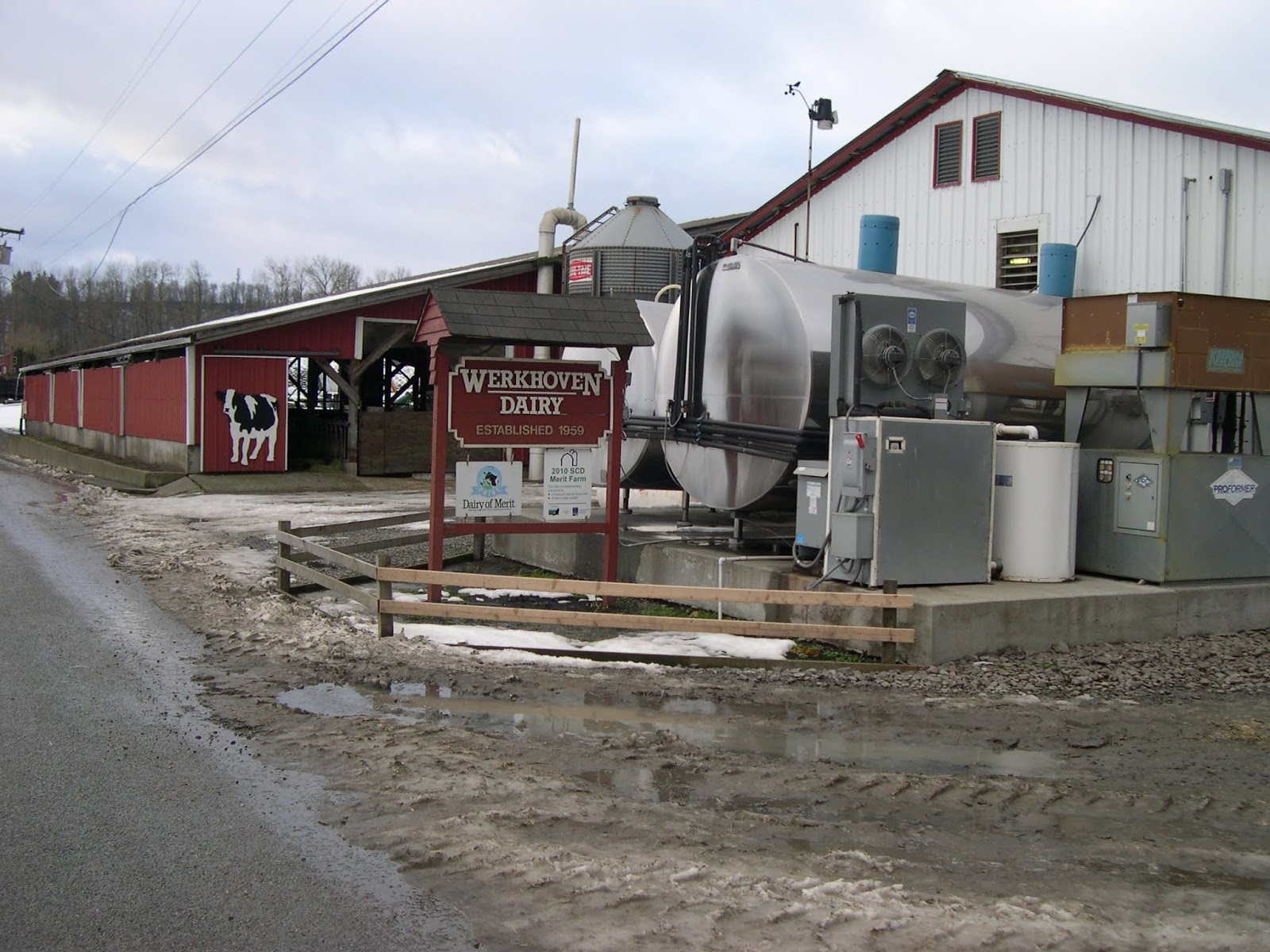
The farming business is at the mercy of Mother Nature and I take some comfort in the fact the weather gods have granted the Werkhoven dairy operation a short window of dry weather in which to harvest their corn and pasture grass. 


The corn crop of seven hundred plus acres is now a mountain of tractor-packed silage in the silage bunkers. As we pedal by the huge mound, the Werkhoven crew, family mostly, spread huge tarps over the pile and secure them with tire-like weights. The silage will cure and ferment for a few short weeks and then become a daily staple of the herd's diet (locally grown in the cows' backyard) to supplement the alfalfa hay trucked in (with voices, I might add, equally grating) from the hayfields in the center of the state.


Though I've several times been witness to this Valley ritual, I remain amazed at how 1000 acres of corn and grass, the work of spring and summer, can be compacted into an area less than  half an acre, a feat that seems to fly full force in the face of physics....
The laborers seemed only too happy to pause a moment from their work to grant The Ripple a photo or two. But not without a quid pro quo, the surety that their enthusiastic waving will be imprinted on the Valley history in The Ripple's pages. I was only too happy to oblige.... 


Saturday, September 14, 2019

The Procession of the Equinoxes...


I saw a cartoon the other day--"The Family Circle," I believe--where the little girl shares with her brother that the remaining months of the year all end with "brrrrr," a strange, but apt coincidence--at least for us in the northlands. Just days away from the autumnal equinox, The Farmer's Almanac, that beacon of weather prognostication, has published its 2019 winter prediction. TFA has added a new phrase to the lexicon of ominous wintry weather. Whereas we northern folk have become all too familiar with "polar vortex,"The Farmer's Almanac has forewarned that winter 2019 will be a "polar coaster." But if you live west of the Rockies, rest easy: the "coaster" will target the mid-west and the east coast. The Almanac appears to have smiled favorably on us westerners, predicting a mild winter with near normal temperatures and precipitation.

There are those who scoff at the prescient Almanac. If you are one of the doubters, there are other predictors of bad winters to come. I came across a list of twenty of these old saws the other day and thought I'd comment on some with the Valley in mind.

Number one: "Thicker than normal Corn Husks." Considerable amount of corn in the Valley, fields of which I cycle by often. Normal looking ears of corn to me as I pass. Sweet corn is coming on, too, and the ears I've shucked seem to be no huskier than normal.

Number four: "Early departure of geese and ducks." The Valley's migratory water fowl just commute anymore, don't they?

Number five: "Early migration of the Monarch butterfly." Sightings of these iconic butterflies are rare in the Valley. I've only seen two in the forty plus years we've lived here. And those two, I doubt, were migrating.

Number six: "Thick hair on the nape of a cow's neck." I'll leave that diagnostic to the Werkhovens.

Number seven: "Heavy and numerous fogs during August." No worries on that one. Just a few the last of the month--and light ones, too, gone before mid-morning. Hey, my tomatoes have yet to show signs of late blight.

Number 10: "Early arrival of crickets on the hearth." Crickets? In the Valley? Have you ever seen or heard one? Pantry moths, however: we've had a blizzard of 'em all summer. I'll endure a hard winter just to rid the house of them.

Number eleven: "Spiders spinning larger than usual webs and entering the house in greater numbers." Not this year. Usually I have to bushwhack my way out the front door and into the garden. If I thought they'd set snares for the pantry moths, I'd leave the doors open night and day.

Number seventeen: "See how high the hornets nest, 'twill tell how high the snow will rest." Hornets here nest in the ground. Disregard that one....

Number eighteen: "The size of the orange band on the wooly bear (or wooly worm) caterpillar." I have yet to see one this year. (By the way, after the woolies go through the change, they become an attractive bug, the Isabella tiger moth.)


My favorite is number twelve: "Pigs gathering sticks." If I happen to see Grammy and Charlie heading to the barn with mouthfuls of sticks, all bets are off. I'm heading to Lowe's for their biggest snow shovel....


Saturday, August 3, 2019

And to Think that I Saw it on Mulberry Street...


I offloaded Gladys in the Swiss Hall lot around 9:00 a.m. just in time to exchange greetings with Andy Werkhoven. "Good morning, Mr. Werkhoven." "Good morning," Mr. Johnson as Andy flagged down a big Massey Ferguson tractor chopping grass, trailing the conflicting odors of diesel exhaust and new mown hay.

On down the road we ting-a-ling a woman slapping blue paint on the east side of Sam Werkhoven's old place. In full sun, too. Summer painting advice: "Follow the shade, Ms."

A quarter mile later we see Kelly Bolles tractoring a brush hog over his strawberry field. Easier to find those lost strawberry plants?

Off to the south a helix of buzzards soaring higher and higher in a Valley thermal. A good omen for Brother Tim who has a hand launch glider contest today in Carnation. (Buzzards achieve maximum results from a minimum of effort.)

I pass Bill Boyce returning from his early morning reconnoiter in the Valley wilderness area.

On over Riley Slough ("Tualco Slough," the sign reads). The resident blue heron apparently gone fishin' elsewhere.

Bridge construction site was silent this morning. The weekend, perhaps? But then this is a County engineering affair. Nine 103' long pilings for deck support left to drive. Are the other forty-three already resting on bedrock fifty feet below?

On the return leg below Decks' hayfield I come upon a man and his dog out for a stroll. As the dog turns to wait for his master, I discover the four-legged companion is in fact a coyote pup. We startle it from behind and it quickly bolts into the corn. "A young coyote," the walker smiles as we pass. "I just saved your life," I joke.

Andy Werkhoven again, this time piloting the big Massey Ferguson limo, chauffeuring a small boy (grandson, perhaps?) I wave. Andy tries to coax a return wave from the lad but he wasn't having any of it.

Just not much going on in the Valley this morning....

Tuesday, July 23, 2019

On the Loose in the Valley...


Usually it's midday when Gladys and I take our morning exercise. Midsummer now, the days hotter, so today I decided to take advantage of the cool morning and still air (Gladys hates a headwind). Backing into the Swiss Hall parking lot, I was surprised to see the environmentally sensitive Nancy L chatting with a woman on the Hall's back porch. Out for her walk, I thought, ever vigilant the Valley isn't filling up with trash. As I was offloading Gladys, Nancy L wandered over to share news that four of Werkhovens' calves had escaped and were out and about somewhere in the Valley. "They found one," she said, " but three are still on the loose." I looked across the field to where a band of green stood out above the pasture grass. This summer's corn crop. As I pedaled off, I told Nancy I hoped the calves weren't out there somewhere in the corn.

The corn stalks are chest high or taller and put in me in mind of our trip to the mid-west ten years ago. We had left the main drag to visit South Dakota's Badlands National Park. At one of the "scenic viewpoints" we looked out over what looked like miles and miles of humongous inverted egg cartons. Mountains of mounds and hillocks as far as the eye could see. A sightseer who shared the view with us remarked: "Helluva place to lose a cow." I'm sure those words had been spoken at that site countless times, but they were original to me, and I thought about them again, this time in the context of acres of corn and three stray calves.

On down the road a ways I was glad to see a fellow and three girls insinuating themselves between three spotted calves and the verdant cornstalks. The lost had been found and were now being chaperoned back to the calf pens. "Ah, the escapees," I told the cowherds as I pedaled by. "Just glad they weren't in the corn," the man replied.

As we pedaled by the stands of corn along the river I wondered what course of action Werkhovens might take in the future should more wayward stock wander into the corn. Aerial surveillance? A drone perhaps? It seems like those high tech whirlybirds are everywhere these days. (A couple Saturdays ago a drone was flitting back and forth over the heads of a wedding party at the event venue south of our slim acre; a wedding photographer had taken his art airborne.)

On the return leg I came upon Steve Werkhoven and the three young lady cowherds by the dairy milk house and stopped to fill in the rest of the story. There are many a head of calves at the dairy, and I was curious how they knew some of the herd were missing. One of the girls said someone had seen them running along the road and then out in Decks' hayfield. They were able to corral one but the other three escaped and disappeared. It was then I learned my thoughts had dovetailed into calf recovery. Steve said Decks had a drone, did a flyover of the area, and located the calves sauntering along the riverbank. All that remained was to herd the prodigal bovines back to the calf stalls. Werkhoven told me the dairy had seven hundred acres planted in corn. " A drone might be a good investment,"I told him. "Yeah," he replied, "They usually just hang around the calf barns though," and went on to say they'd have wandered home sometime anyway.


Maybe so, I thought, yet the dairy folks had had to leave their morning routines to retrieve them, hadn't they? Without the aerial reconnaissance they might still be searching. And that seven hundred acres is one helluva big corn maze....

Monday, July 22, 2019

Grammy...Or Charlie?...


It's hard to believe Kelly Bolles' great horticultural experiment, trifling with truffles, (Trifling for Truffles or there's a Fungus Among us in the Valley), is now in its eighth year. I think about his project and those exotic 'shrooms every time Gladys and I huff and puff our way past the oak and hazelnut grove especially planted to foster a crop of the gourmet fungi. Five years, Kelly told me, the earliest he could expect any sort of crop. "If I could just find a truffle like this, " Kelly grinned, configuring his fingers in the shape of a softball, "I'd have it made." Or something to that effect, in other words a gourmet gold nugget....

Whenever I see Kelly these days, I ask for an update. As of this post the Valley's sometime truffle king has yet to unearth a single gnarly corm. I'm no expert on truffle horticulture, certainly haven't done the research Kelly has on the crop, which he geared to the Pacific Northwest truffle industry that's well established in Oregon. My knowledge of the elusive fungi is limited to European truffles, a subject that crops up every so often in the news. For centuries in truffle country, especially France, truffle foragers have used the keen olfactory ability of pigs to locate and root out the treasured mushrooms. In keeping with Old Country tradition, come potential harvest time, Bolles purchased a pair of porcine truffle seekers, but I wonder if Kelly's new help might have put his fungal venture in jeopardy.

Here's where the Valley truffle adventure becomes more interesting. Pigs love truffles just as much as the French gourmand. Once a truffle hog roots up a prize, the pig's handler must pounce on the find immediately before his assistant can scarf it down. I'm sure Kelly was aware a truffle sniffer could and would down the crop if the handler didn't quickly intervene. Perhaps Kelly's research focused on the growing of truffles more than the harvesting of them. Not sure about that, but after the fact, when the pigs were hired on, Bolles learned that a potential truffle hunter has to be trained in the art, training that should begin at the piglet age. Kelly's two pigs? Both mature hogs. And apparently you can't teach an old hog new tricks.

You might say the pocine pair are now a Valley fixture, and as you drive the Lower Loop Road south of Werkhoven corner and happen to see afield what appear to be two large dogs in the vicinity of Kelly's truffle grove, those'd be Grammy and Charlie. I caught them unaware the other day and thought I'd snap a photo, but when I approached, Grammy...or Charlie was having none of it, snorted and waddled briskly off, presenting only his or her porkly backside to the camera.

"How are Grammy and Charlie these days?" I asked Kelly last fall when our paths crossed.  It was flood season and he was worried about them. "They weigh nearly four hundred pounds apiece," he told me. "If we have a flood, I can't pick 'em up...they'll drown. I need to build a critter pad so they can escape should it flood." He has yet to build a higher ground refuge but as it's not flood season, I don't think mounding a pig escape is Kelly's priority.

When I mentioned bacon, pork chops, and cracklin's, Kelly laughed and shook his head. As we pet owners know, naming an animal elevates its status to that of pet, and it appears Grammy and Charlie are now part of the Bolles's household, not likely to become pulled pork or pan fried side meat. But Kelly's always looking for an angle: "Maybe I should train and sell truffle dogs," he chuckled,  "There's real money in that..." as a trained truffle dog has little interest in downing a pricey mushroom. While he's sharing this with me, I'm thinking about Grammy and Charlie, the way they've bulked up, and how I frequently see them rooting about in the truffle grove. Perhaps they're finding more there than cover and shade?

Meanwhile when fall rolls around, Kelly has hazelnuts for sale and even extends the courtesy of a stock tank in which one can dunk his hazelnuts to see which sink or float (the floaters contain no meat). I'll close this post by sharing a question I put to Kelly one day: "How can you tell which is Grammy and which is Charlie; their markings are the same?" "Charlie has tusks," he said,... good information to have the next time I get close enough to snap another photo.


Wednesday, July 3, 2019

The Glorious Fourth...


The Fourth of July was the memory of a new republic, a bloody babe of destiny, waiting to be filled with soul.

Ross Lockridge, Jr.                                           
Raintree County                                         
                                                                                             

To look at the sweet corn you wouldn't believe it. Independence Day, 2019, and the corn is yellow and stunted, barely ankle high. Looks like"Knee high by the Fourth of July" will have to wait for the next corn season. I tilled up the first planting which yielded a meagerly dozen sprouts out of two rows. The second planting, while well-sprouted, lacks the robust growth corn usually experiences this time of year. But please excuse the corniness. The subject of this post concerns the 243rd birthday of this our Grand Republic.

This Glorious Fourth, I'll spend like last year's: listening to Sousa marches and the patriotic songs rendered by the forceful chorus of the Mormon Tabernacle Choir from their "Spirit of America" CD. The pyrotechnics I'll leave to the younger, more adventuresome set; those days of crump, crackle, and boom I've left behind, thankfully with all fingers and limbs intact, hearing only slightly diminished. I'll miss, however, the homemade ice cream and butterscotch brownies.

In honor of the day perhaps I should revisit the Declaration of Independence, brush up on the Constitution of the United States, read some of the fine print. Or perhaps a bit of Thomas Paine.... (Seems to me the pamphleteer's messages are currently--and sadly--foreign to the powers that be.)

But no thanks. On this celebratory day I can't think of a more patriotic thing to do than pull my favorite novel from the bookshelf, the only novel this confirmed reader has read twice, flip through the pages to my favorite passages (my copy bristles with sticky notes), and revisit the grand panoply of our Great Republic in the latter half of the 19th Century.

Raintree County is a sprawling novel. And at times a brawling novel. (The manuscript Lockridge delivered to Scribner's publishing weighed twenty pounds.) It covers a tumultuous epoch of our country's history, the britches bustin' period spanning the Clay/Polk presidential election of 1844 to  1892, a half decade that saw the Westward movement and the closing of the frontier, the Civil War and the Emancipation Proclamation, and the transcontinental linking of our infant railroad system, "binding ocean to ocean in bands of steel." The fulcrum of the story line is July Fourth, 1892, and the slate of celebratory events scheduled for the day. The story begins with protagonist Johnny Shawnessy preparing to participate in the festivities. Events of the day trigger flashbacks that skip the story back and forth across five decades of history including seven memorable July Fourths. Though successive chapters might record events decades apart, the ending sentence, each incomplete, is skillfully linked to the beginning sentence of the next. This device, though delightful, makes the novel a challenge to read. Every Glorious Fourth I consider it a patriotic duty to revisit Lockridge's epic novel and thus once again...

happy birthday to our Grand Republic. May it thrive and prevail as a safer...and more to the point, saner beacon for the world.


Wednesday, June 26, 2019

HARD HAT AREA...


Are you familiar with the American folklore hero John Henry? A few days back I was reminded of that legendary steel drivin' man. A rhythmic "clang, clang, clang" from the Valley gave me a welcome pause from the hoe handle. Metal on metal it was. A persistent metallic echo you could almost feel through your feet, beating time as if it were the percussion section for a gandy dancer's chant. "Who or what is pounding away out there?" I wondered and almost immediately remembered an email I'd received from Matt Beebe, The Ripple's down Valley reporter with an update on the Bridge 155 replacement project which began in April (after a two week delay) and is slated for completion by January 13, 2020.

According to Reporter Beebe after the old bridge is demolished, the County's contractors will set fifty-two metal pilings across Riley Slough, deck support for the new bridge. Each piling will be driven fifty feet down to Valley bedrock (as per current County seismic code, I'm sure). The "clang, clang, clang?" A pile driver rending the peaceful Valley air with an irritating cacophony. The construction crew will set the pilings on the north and south banks of Riley but as the slough is a "salmon" fishway (according to Matt, the last salmon he saw in Riley Slough was in 1985 and that at his childhood residence back up Ben Howard Road) workers will defer setting pilings in the watercourse proper until sometime in July--after spawning season, so as to disturb for now, Matt shared, "only the frogs and salamanders."

More news. The environmentally sensitive Nancy L, out for a walk in the Valley, watched in amazement as a truck pulling "the longest trailer I ever saw" hauling four steel pilings slalomed its way to the construction site. We both wonder still how the truck, pilings in tow, was able to negotiate the right angle curves on the upper Loop road. Nancy L suggested I check out the construction site: "There's some mighty big equipment there," she said. So today Gladys--an amazing bit of equipment herself--and I ventured out to gather some news....


Our ride to the construction site was one of contending fragrances...olfactory ambivalence, if you will. As we rolled by Broers' berry fields, the midday sun brought forth the sweet, almost cloying, smell of ripe strawberries. But strawberry fields don't last forever and further down the road Gladys nearly balked as we happened upon Andy Werkoven, boot tops awash in verdant froth and foam gushing from one of the poo poo sprinkler valves. Strawberries and liquid poo, pungent enough to clear the clogged sinuses of an elephant.


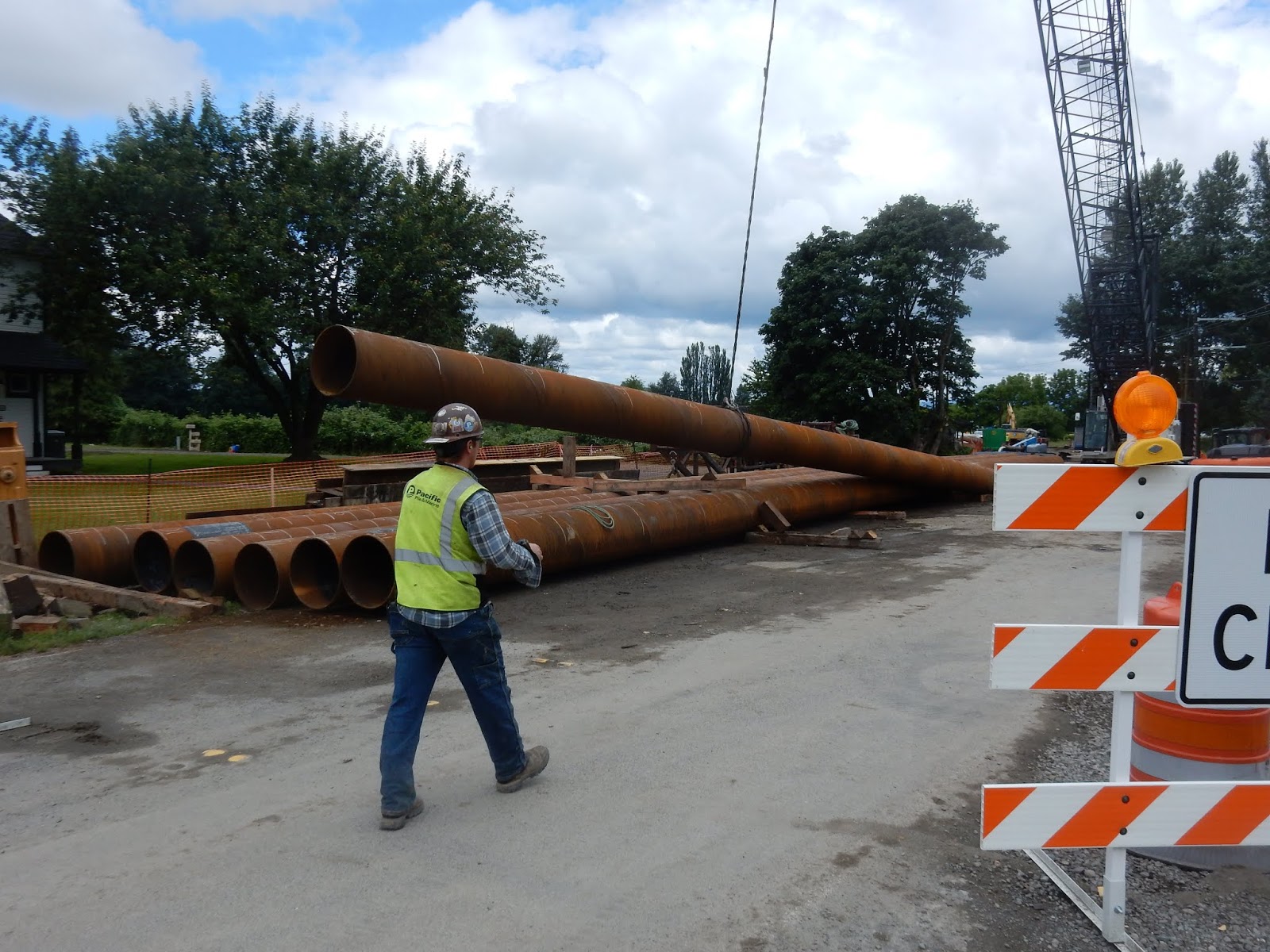
We grind to a stop past the "road closed" sign and find ourselves in the presence of "some mighty big equipment." In the shade of a large crane a pair of hardhats were chokering up one of those huge pilings. The more diminutive of the two walked my way. From the look of his battered headgear, I could tell he'd been around the construction trade for some time. "How long are those pipes?" I asked. "Shorty" shot me a proud smile: "103 feet," as if to boast that size does make a difference. (I estimated the diameter of each about eighteen inches.) I shot a few photos and then crossed the lawn of the old Victorian two story to take more shots of the work in progress in and around the slough. A couple of the pilings protruded from their fifty foot bedrock pillows. I noticed workers had installed a miniature caisson to keep the sluggish slough waters at bay and thought: " Frogs, salamanders, and salmon, watch out."


My photo op concluded when Shorty, gesturing toward a tilted up, huge piling, shooed me away from the danger zone. "Wouldn't want you to be on the news," he explained, referencing, I'm sure, some of the crane accidents in the news of late. "I've seen it happen, and it's not pretty."

After Shorty herded me out of harm's way, I asked him if I could wait until the bridge was finished so Gladys and I could continue our ride. "You'd be pretty hungry by then," he chuckled.  I went on to ask about the project timeline, if the work was proceeding as scheduled. The answer? Shorty shrugged his shoulders. I followed up with, "How about cost overruns?" "You have a good day," he said, striding briskly toward the hard hat area. The interview was over.

 And for now that's the news from the Hard Hat area....